The fastest way to get Korean snacks wrong is to buy what looks trendy rather than what actually moves. For retailers, importers, and foodservice buyers, how to stock Korean snacks is not just a merchandising question. It is a margin, supply, and repeat-order decision that affects shelf performance over time.
Korean snacks continue to win attention because they combine novelty with strong repeat appeal. Shoppers may try a product for the packaging or flavour profile, but they come back when the product delivers on taste, consistency, and availability. That means your stocking strategy needs to balance trend-led demand with dependable core lines.
How to stock Korean snacks with a commercial mindset
If you are sourcing for resale, the first decision is not which single product to buy. It is what role the category should play in your business. In a specialist Asian supermarket, Korean snacks may be a destination category with broad flavour depth. In a mainstream grocery setting, they may sit as a high-interest imported range that needs clear bestsellers. In foodservice or hospitality, the right snack selection may support retail corners, grab-and-go offers, or meal bundle add-ons.
This matters because volume planning changes by channel. A supermarket buyer may need a wider mix with moderate case depth. A distributor may need scalable core SKUs that can move across multiple customer accounts. A restaurant group or café operator may want a tighter selection with reliable replenishment and long shelf life. Good category planning starts with your customer base, not with a catalogue.
The strongest Korean snack ranges usually have three layers. First, you need proven volume drivers. These are the products customers recognise quickly, reorder often, and recommend to others. Secondly, you need flavour variety to maintain interest and increase basket size. Thirdly, you need a small set of seasonal or trend-led items that create urgency without exposing you to unnecessary dead stock.
Start with products that already have demand
When buyers ask how to stock Korean snacks effectively, the safest answer is to build around products with established sell-through. Too many ranges are overbuilt around novelty. Novelty helps with first purchase, but it does not always support steady rotation.
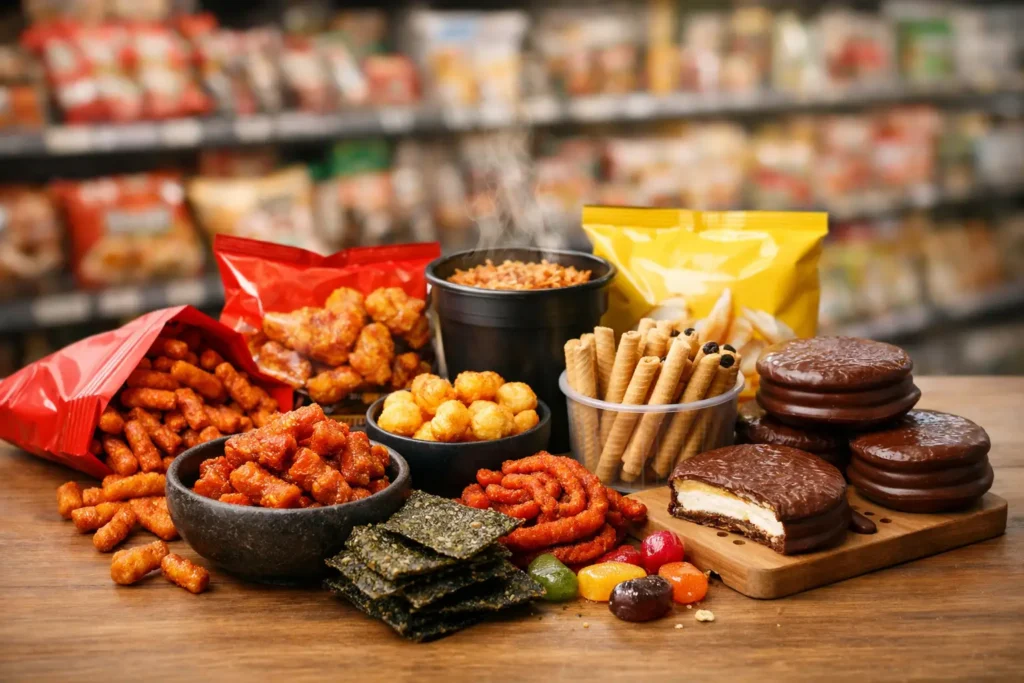
In practice, this means prioritising snack types that already perform well in export markets. Seaweed snacks, Korean chips, coated nuts, rice crackers, sweet biscuits, chocolate snacks, and portable savoury items all have a role. Within those segments, spicy and bold flavours often attract attention, but milder and familiar options are what broaden your customer base. A range made entirely of extreme flavours may generate social media interest, yet it can limit repeat purchasing among general shoppers.
Brand recognition also matters. Where Korean food demand is already developed, recognised brands give buyers more confidence and reduce hesitation at shelf level. Where the market is earlier stage, recognisable Korean branding still helps because it signals authenticity. For wholesale buyers, that translates into easier resale conversations and stronger trust with retail accounts.
If your wider catalogue includes Korean noodles, sauces, and pantry goods, snack purchasing should also support cross-category sales. Customers who buy Korean instant noodles often buy snacks from the same country of origin, especially when merchandising creates a clear Korean section. That is one reason many commercial buyers source snack lines alongside ramen and sauce categories rather than treating them separately.
Build around core, support with variety
A practical range does not need to be enormous. It needs to be disciplined. Start with bestsellers that can carry the category, then add enough variation to keep the shelf relevant.
A sensible mix often includes familiar savoury formats, a few sweet options, and some bolder flavour lines for customers actively seeking Korean food trends. Pack size should reflect the outlet. Convenience-led retailers may favour smaller grab-and-go units, while supermarket groups and wholesalers may want more family-sized or value-oriented formats. Foodservice operators often benefit from impulse-friendly units that are easy to display near tills or in takeaway zones.
Pack size, pricing, and margin all need to work together
Stocking Korean snacks is not only about demand. It is also about whether the landed cost, retail price, and rate of sale create a viable business case. Imported snacks can attract premium positioning, but price tolerance still depends on format, brand strength, and local market expectations.
A lower-cost item with weak rotation is not automatically better than a higher-ticket line that moves consistently. Equally, a premium imported snack may have strong appeal in a city-centre speciality store and struggle in a value-led suburban chain. The right decision depends on your customer profile and your shelf economics.
That is why case configuration deserves attention early. If minimum order quantities are too high for a trial, you increase the risk of overstocks. If case counts are too low, replenishment becomes inefficient. Buyers should evaluate not only unit margin, but also storage footprint, breakage risk, shelf life, and reorder cadence.
For distributors and importers, there is another layer. Your customers need enough margin space to promote and reorder with confidence. Products that sell well but leave little room for downstream profit can become difficult to scale across accounts.
Shelf life and logistics are part of the stocking strategy
One of the most overlooked parts of how to stock Korean snacks is supply planning. A strong range can still underperform if replenishment is inconsistent. When a product gains momentum and then disappears, buyers lose sales twice – once from the stockout and again from reduced customer trust.
Imported snack procurement should be planned around realistic lead times, customs processes, and inventory buffers. This is especially important if you are working across multiple markets or managing promotional periods. Korean snack demand often spikes around cultural trends, gifting periods, and social media exposure. If your supply chain cannot support those peaks, the opportunity can pass quickly.
Shelf life should also guide range selection. Most packaged snacks travel well, but not all products carry the same operational flexibility. Buyers with longer supply routes or slower category turnover should prioritise items that offer a comfortable sales window after arrival. That does not mean avoiding faster-moving trend products. It means matching them to the right outlets and order cycles.
A dependable wholesale partner adds value here by helping you balance authenticity with logistics discipline. Direct sourcing, export experience, and responsive account support matter because snack buying is not a one-off event. It is an ongoing replenishment model.
Avoid the common stocking mistakes
The first mistake is overestimating novelty demand. A few eye-catching products are useful, but they should not dominate the range. The second is underestimating the value of broad appeal flavours. Not every customer wants maximum spice or unusual seasoning profiles.
The third mistake is buying without a channel plan. A product that works in independent Asian retail may not fit supermarket planograms or foodservice counters. The fourth is treating snacks as a side category with no replenishment discipline. In reality, snacks often generate repeat impulse sales when availability is consistent.
Merchandising decides whether the range performs
Even the right product mix can underdeliver if presentation is weak. Korean snacks sell best when customers can identify them quickly and shop them with confidence. Clear grouping by cuisine, flavour style, or snack type helps reduce hesitation, particularly for customers who are interested in Korean food but not yet deeply familiar with the category.
Cross-merchandising can lift performance. Korean snacks placed near instant noodles, sauces, or meal kits often benefit from the wider interest in Korean cooking and convenience foods. For wholesalers supplying retail accounts, this is worth discussing at account level because placement has a direct effect on sell-through.
In stores with limited space, less is often better. A tight, high-turning selection presented well will usually outperform a cluttered display of slow movers. For larger formats, a broader assortment can work if the range is still anchored by core products with established demand.
Choosing a supplier is part of how to stock Korean snacks well
The product itself matters, but so does the structure behind it. Buyers need more than access to a catalogue. They need confidence in authenticity, case availability, export handling, and repeat-order support.
That is where supplier selection becomes commercial rather than administrative. A trusted global partner should be able to help you identify high-potential lines, manage bulk ordering requirements, and support ongoing supply across borders. For buyers scaling Korean categories, that operational reliability often matters as much as the initial product selection.
SAMYANG FOODS STORE is positioned for that type of buyer – wholesale-focused, authenticity-led, and built around bulk supply of genuine Korean food products for international trade channels. For importers, distributors, supermarkets, and foodservice operators, that kind of sourcing structure reduces friction and supports growth.
The best Korean snack range is rarely the widest one on paper. It is the one that reflects real customer demand, protects margin, and can be replenished without disruption. Stock with discipline, back proven sellers, and leave enough room for selective trend lines. That is how a snack category moves from curiosity to dependable revenue.
