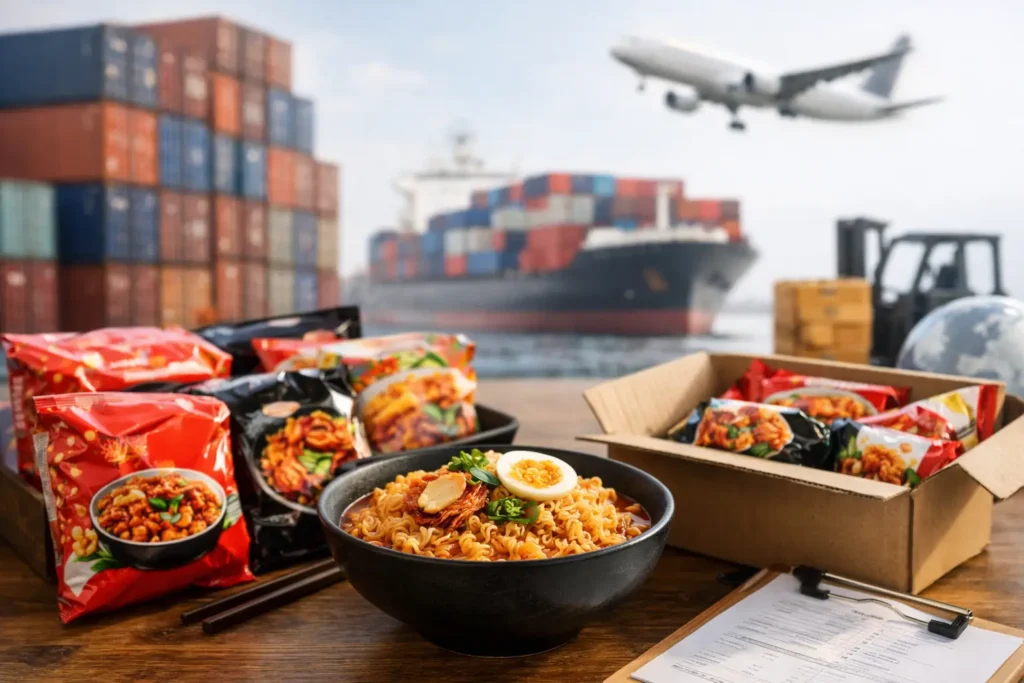
If you are asking how to import Korean noodles, the real question is not simply how to get cartons from Korea to your warehouse. It is how to build a repeatable, compliant, margin-sensible supply line for a category that moves quickly when you get the brand mix, paperwork and logistics right. For wholesalers, supermarket buyers and foodservice operators, Korean noodles are no longer a niche add-on. They are a proven demand driver.
The opportunity is obvious, but so are the mistakes. Buyers often focus on headline pricing and overlook labelling, product registration, shelf-life exposure during transit, or the difference between a factory-direct supply partner and a trading intermediary. In this category, small procurement errors become expensive once stock is on the water.
How to import Korean noodles without costly delays
The fastest way to create problems is to treat Korean noodles like any other dry grocery line. They are shelf-stable, but they still sit inside a regulated import framework. Each market has its own rules on ingredients, allergen declarations, language requirements, customs codes and importer responsibilities. Before you place a bulk order, confirm exactly what your destination country expects.
For UK and international buyers, that usually means reviewing import documentation, checking whether product labels meet local standards, and confirming that ingredient statements translate cleanly into compliant pack copy. If your range includes spicy chicken ramen, stir-fried noodles, cup formats or multipacks, do not assume every SKU can be handled identically. Different packaging formats can affect carton dimensions, freight planning and retail suitability.
A strong supplier should be able to provide product specifications, packing lists, commercial invoices and origin details without hesitation. If those documents arrive late or incomplete during pre-sale discussions, it is usually a sign of what will happen later under shipment pressure.
Start with market demand, not just catalogue breadth
Commercial buyers do not win by importing everything. They win by importing the right lines in the right volumes. Korean noodles perform best when your first order reflects local demand patterns rather than personal preference or trend headlines.
Spicy Korean noodle lines, especially recognised export favourites, often deliver the strongest initial traction in ethnic retail, convenience, online resale and foodservice menu applications. But demand varies by territory. Some markets respond well to extreme heat and novelty. Others move better with milder flavours, classic ramen profiles, or cup noodles aimed at lunch and impulse purchase occasions.
This is where procurement discipline matters. A broad catalogue looks impressive, yet too many SKUs can slow stock rotation and increase complexity across customs, storage and replenishment. A focused opening range is usually stronger. Start with proven sellers, assess velocity, then widen the assortment once you have reorder data.
Supplier selection decides your risk profile
When buyers ask how to import Korean noodles successfully, supplier selection is usually the turning point. There is a major difference between sourcing through layered middlemen and working with a wholesale partner built for cross-border food distribution.
The right supplier should offer more than product access. They should understand export packing, document accuracy, lead times, production scheduling and the practical demands of container planning. Reliability matters as much as price. A cheaper shipment that arrives late, with poor pallet configuration or inconsistent paperwork, can cost more than a correctly managed order from the start.
Ask direct commercial questions. What are the minimum order quantities by SKU? Can mixed containers be arranged? What is the standard production lead time? How is shelf life managed at dispatch? Are labels already export-ready, or does relabelling need to happen on arrival? If a supplier cannot answer clearly, the risk sits with you.
For serious buyers, authenticity also matters. Korean noodle demand is tied to brand recognition. Customers know what they are looking for, especially in categories such as hot chicken noodles and premium instant ramen. If the source is unclear, resale becomes harder.
Compliance, labelling and product checks
This is the least glamorous part of the process and one of the most important. Before ordering, confirm ingredient compliance, allergen statements, nutritional panels, barcode readiness and country-specific packaging rules. If your market requires local language labels, decide whether products will ship pre-printed or be relabelled in-country.
Do not leave this to freight agents alone. Customs clearance may still go through, but retail acceptance is a separate issue. A supermarket buyer or chain compliance team can reject stock that technically entered the country but does not meet shelf requirements.
It is also worth checking whether your market has specific scrutiny around additives, meat-derived ingredients, or promotional claims on pack. Some noodle SKUs are straightforward. Others need closer review. That does not mean the range is unsuitable. It simply means the import process needs to be managed properly before purchase orders are issued.
Freight planning affects margin more than most buyers expect
Korean noodles are compact, but freight still shapes profitability. The balance between sea freight and air freight depends on urgency, order size and your sales model. Air freight may work for samples, urgent replenishment or new market testing. For steady wholesale supply, sea freight is normally the better commercial fit.
Container efficiency matters. Carton counts, pallet heights and mixed SKU loading all affect landed cost per unit. If you are importing for retail chains, convenience distributors or foodservice depots, your ideal case mix may not be the same. Retail often wants broader flavour variety. Foodservice may prefer heavier concentration in fewer fast-moving lines.
Lead time planning is equally important. If you only reorder when stock is nearly gone, you are already late. Korean noodle demand can spike around social media trends, promotions and seasonal campaigns. Build reorder points that account for production time, port congestion, customs handling and final inland delivery.
Calculate landed cost properly
Too many buyers assess only ex-works or FOB pricing and then wonder why margins tighten after arrival. A proper landed cost model includes product cost, freight, insurance, customs duties, clearance charges, local haulage, warehousing, relabelling if required, and any compliance testing or inspection costs.
Once that figure is clear, compare it against your intended channel. Wholesale distribution, supermarket resale and foodservice supply all have different pricing tolerances. A noodle line that works well in independent retail may feel too tight in a chain environment if listing fees, promotional support or delayed payment terms apply.
This is why bulk procurement needs to be tied to a channel strategy. Importing Korean noodles is not just about buying popular stock. It is about buying in a volume and cost structure that still leaves room for healthy margin after every operational charge has been accounted for.
Build a reorder system before the first shipment lands
If the first container sells well, the next issue is continuity. Buyers often spend so much energy getting the initial import completed that they neglect the replenishment cycle. In this category, stock-outs are expensive. Once customers find a preferred line, they expect repeat availability.
A strong reorder system tracks sales by SKU, channel and region. It also separates true demand from short-term promotional spikes. If one flavour moved quickly because of a launch discount, that does not always mean it deserves a larger standing order. On the other hand, if a core hot chicken variant is selling steadily across retail and foodservice, it may justify deeper stocking and more frequent replenishment.
Working with a dependable wholesale partner helps here because visibility matters. If your supplier can provide realistic lead times and support mixed replenishment planning, you can manage cash flow and inventory with more confidence. Businesses such as SAMYANG FOODS STORE position themselves around this exact requirement – authentic Korean product access backed by export coordination and repeat-order support.
Common mistakes when importing Korean noodles
The most common error is buying too broadly on the first order. The second is underestimating compliance work. The third is choosing a supplier based on unit price without checking whether they can actually support wholesale execution.
Another frequent issue is ignoring shelf-life at dispatch. A good landed price loses its appeal if too much usable shelf life has already been consumed before the goods reach your warehouse. Finally, buyers sometimes overlook local sales fit. A product can be globally famous and still need the right channel, pack size and flavour selection to succeed in your specific market.
A better way to approach your first order
Start with a commercially disciplined range. Confirm compliance before payment. Make landed cost your pricing baseline, not an afterthought. Choose a supplier that understands export operations, not just product trading. Then build your reorder plan as early as your opening purchase order.
That is the practical answer to how to import Korean noodles in a way that supports long-term resale rather than one-off buying. The businesses that do well in this category are not simply chasing a trend. They are treating Korean noodles as a serious growth line, with the same attention they would give any high-turn imported grocery category.
If you get the sourcing, documentation and replenishment model right from the beginning, Korean noodles can become one of the most dependable repeat-purchase lines in your range.

Pingback: How to Stock Korean Snacks That Sell – SAMYANG FOODS STORE
Pingback: B2B Ramen Procurement Checklist That Works - SAMYANG FOODS STORE
Pingback: Direct Sourcing Korean Food Brands - SAMYANG FOODS STORE