A delayed noodle shipment rarely looks serious on paper. On shelves, in distributor depots, or on a menu rollout, it quickly becomes missed sales, frustrated buyers, and unnecessary pressure on your team. A strong B2B ramen procurement checklist helps prevent that. It gives commercial buyers a clear way to assess not just product demand, but supply consistency, export readiness, and margin protection before purchase orders grow.
Korean ramen is no longer a niche line in many markets. For supermarkets, Asian grocers, wholesalers, and foodservice operators, it has become a repeat-purchase category with real velocity. That creates opportunity, but it also raises the standard for procurement. If demand is proven but the supply base is weak, the category becomes difficult to scale.
Why a B2B ramen procurement checklist matters
In B2B buying, the product is only one part of the decision. A ramen line may perform well with consumers, but that does not automatically make it a sound wholesale purchase. Buyers also need to consider pack formats, lead times, customs documentation, shelf life on arrival, carton quantities, and whether the supplier can handle repeat bulk orders without inconsistency.
This is especially true for imported Korean foods. A trending SKU can move quickly, but if replenishment is unreliable or compliance paperwork is incomplete, the short-term demand advantage disappears. Procurement teams therefore need a framework that balances market appeal with operational discipline.
Start with demand, not just catalogue breadth
A common buying mistake is to treat range size as a sign of procurement strength. In practice, a smaller set of proven ramen SKUs often performs better than a broad line-up with uneven turnover. Before placing volume orders, buyers should look at what already sells in their channel.
For retail, that usually means assessing core bestselling spicy variants, established Korean branded lines, and pack sizes suited to local basket behaviour. For foodservice or cash-and-carry buyers, the picture may be different. Case efficiency, back-of-house storage, and menu compatibility often matter more than novelty.
The right checklist question is simple: are you buying products with repeat demand, or are you filling space with speculative stock? There is room for trend-led purchasing, but not at the expense of dependable movers.
Supplier evaluation in the B2B ramen procurement checklist
A dependable supplier should be assessed on more than price. Cost matters, but procurement risk usually sits elsewhere. Your team should verify whether the supplier can support regular export volumes, maintain product authenticity, and provide responsive account handling when schedules shift.
Look closely at sourcing credibility. If a supplier positions itself around authentic Korean food, that claim should be supported by direct category knowledge, familiarity with branded items, and the ability to discuss product availability in commercial terms rather than generic sales language.
Operational capability matters just as much. Ask how orders are processed, what the standard lead times are, how stock allocation is handled during peak periods, and whether the supplier can support both trial orders and recurring volume shipments. A good supplier will answer directly. A weak one will stay vague.
For many buyers, this is where a wholesale-focused partner makes a practical difference. A business built around bulk procurement understands that consistency, not one-off convenience, is what keeps accounts profitable.
Key supplier checks
Your B2B ramen procurement checklist should cover five essentials: sourcing authenticity, export experience, account responsiveness, stock reliability, and documentation readiness. If one of these areas is weak, the procurement process becomes harder than it needs to be.
It also helps to test communication early. If quote revisions, carton details, or specification requests take too long before the first order, there is a fair chance the same pattern will continue when shipments are time-sensitive.
Product specifications need commercial review
Ramen procurement is not just about choosing flavours. Every SKU should be reviewed as a commercial unit. That means checking net weight, carton configuration, units per case, pallet efficiency, shelf life, ingredients, allergen declarations, and packaging language.
Shelf life deserves particular attention. A product with strong turnover may still be a poor fit if too much shelf life is lost in transit. This is an important issue for importers and distributors serving secondary accounts, where stock may sit in a warehouse before going out again. The best purchase is not always the cheapest landed unit. It is often the unit with the healthiest resale window.
Buyers should also check whether the product format fits their channel. Single packs may suit retail shelves, while multipacks or foodservice-oriented cases may offer better economics elsewhere. The same brand can perform very differently depending on how the format matches the route to market.
Pricing should be judged by margin, not invoice alone
Low ex-works pricing can look attractive until freight, duties, handling, and wastage narrow the margin. A proper evaluation should consider total landed cost, expected sell-through speed, promotional flexibility, and reorder practicality.
This is where experienced buyers separate headline price from real buying value. If a supplier offers a lower unit cost but weak fill rates, slower dispatch, or variable availability, the apparent saving may be lost through stockouts and reactive purchasing.
There is also a channel-specific trade-off. Retailers may prioritise price points and consumer-facing margin. Distributors may place more weight on carton economics and the ability to supply trade customers consistently. Foodservice buyers may accept a different margin structure if the item supports menu demand and kitchen convenience.
Logistics and fulfilment are part of the product
For imported packaged foods, logistics performance is not an afterthought. It is part of the offer. The most commercially attractive ramen line can still become a poor procurement decision if shipping schedules are erratic or fulfilment is unreliable.
A serious checklist should therefore cover dispatch lead time, port routing, export packing standards, transit expectations, and contingency planning during demand spikes. Buyers should know whether their supplier can support regular shipment cycles and whether the business has enough operational depth to solve problems quickly.
Cross-border trade adds another layer. Documentation accuracy, customs readiness, and coordination across regions matter just as much as warehouse stock. Suppliers with international operating experience are generally better placed to support procurement teams that need predictability rather than excuses.
This is one reason many trade buyers prefer working with established wholesale partners such as SAMYANG FOODS STORE when scaling Korean food categories. The value is not only access to authentic products, but the ability to support repeat international orders with practical execution.
Compliance should be checked before growth planning
It is tempting to focus on trending products first and paperwork second. That approach usually causes delays. Importers and wholesale buyers should confirm labelling compliance, ingredient transparency, allergen information, and any market-specific import requirements before committing to larger volumes.
The exact compliance burden depends on destination market, product type, and route to market. A supermarket chain may have stricter onboarding demands than an independent retailer. A foodservice buyer may care more about pack information and handling practicality than shelf-facing claims. Either way, the supplier should be able to provide documentation promptly and accurately.
If compliance support is slow or incomplete at the quote stage, scaling the category will be harder later.
Inventory planning is where good procurement pays off
Even a strong product and supplier combination needs disciplined stock planning. The right order quantity depends on lead time, storage capacity, sell-through speed, and seasonal demand. Buying too cautiously can create out-of-stocks. Buying too aggressively can tie up cash and shorten the resale window.
For ramen, demand can move sharply with social trends, promotions, and regional customer preferences. Spicy variants may outperform in one market while milder lines build better repeat volume elsewhere. Buyers should therefore treat early orders as commercial learning, not just replenishment.
The most effective approach is usually phased. Start with a core range, watch movement by SKU, then expand once reorder patterns are clear. That gives procurement teams better control over working capital while still capturing category growth.
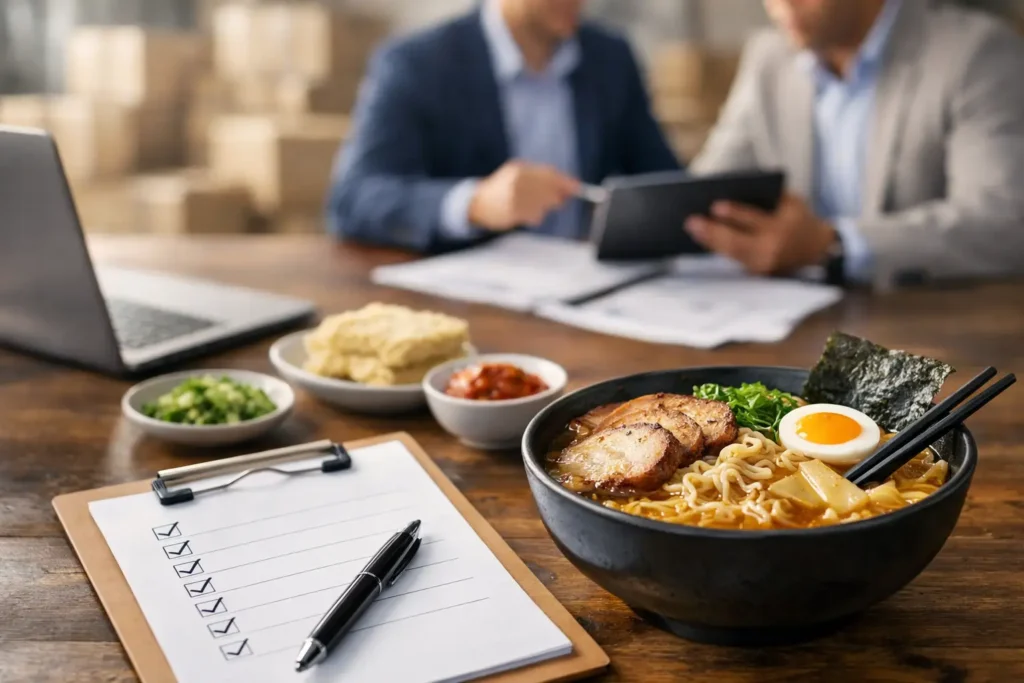
A practical B2B ramen procurement checklist for buyers
Before approving a supplier or range, confirm that the following points are clear:
- Product demand is proven for your specific channel
- SKU formats match retail, wholesale, or foodservice needs
- Shelf life on arrival supports resale timing
- Pricing works on a landed-margin basis
- Export documentation is available and accurate
- Lead times are realistic and repeatable
- Carton and pallet configurations suit your operation
- The supplier can support recurring bulk orders
- Communication is fast enough for commercial buying
- Stock planning reflects demand swings and replenishment cycles
If several of these answers are uncertain, the order may still be possible, but it is not yet procurement-ready.
Strong ramen buying is rarely about finding the cheapest case. It is about choosing a supply arrangement that can hold up when demand rises, schedules tighten, and customers expect continuity. The better your checklist, the easier it is to buy with confidence and grow the category without adding avoidable risk.
