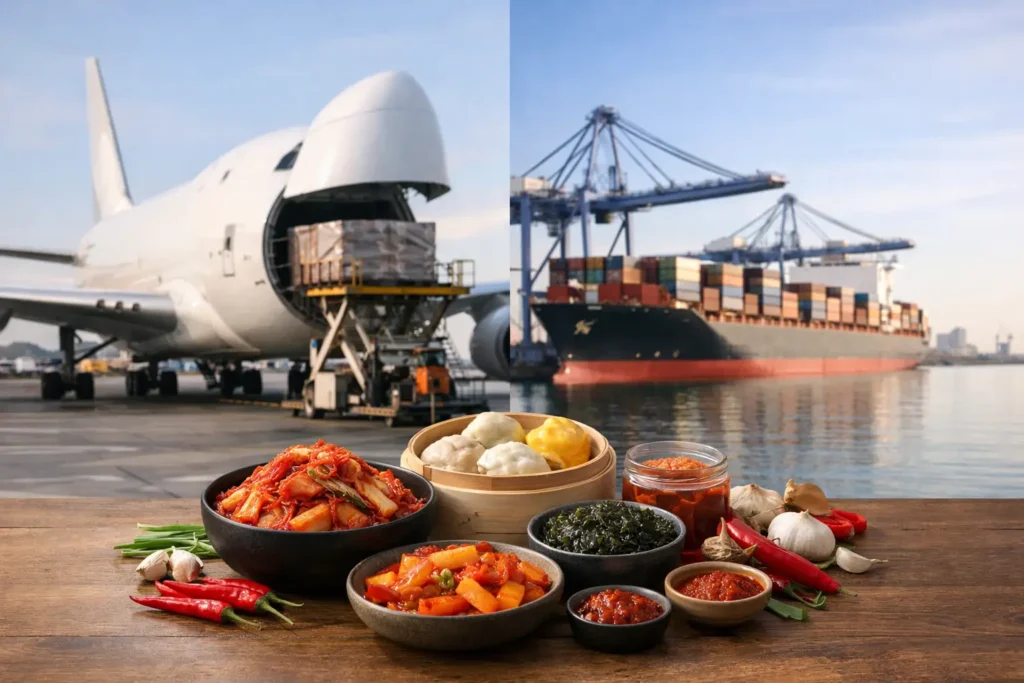
A container of Buldak noodles that reaches your warehouse at the right cost is more valuable than a fast shipment that erodes your margin. Choosing air freight or sea freight affects landed cost, stock availability, product condition and the confidence you can offer retail and foodservice customers. For Korean food importers, the right answer is rarely one mode for every order. It depends on demand, shelf life, order volume and the commercial cost of being out of stock.
Air Freight or Sea Freight: The Core Difference
Air freight moves goods quickly, usually making it the stronger option for urgent replenishment, product launches and smaller high-value orders. Sea freight moves larger volumes at a significantly lower cost per kilogram or carton, making it the foundation for planned wholesale purchasing.
For packaged Korean food, this decision is not simply about speed versus price. Instant noodles, sauces, snacks, seasonings and ready-to-eat products each have different carton sizes, weight profiles, shelf-life requirements and sales patterns. A buyer importing a few pallets of a fast-moving Samyang ramen line has a different logistics requirement from a distributor placing a full container order across several pantry categories.
The most dependable procurement programmes use both modes with clear purpose. Sea freight supports the main inventory plan. Air freight protects availability when a proven product sells faster than forecast or when a key account needs stock ahead of a promotional period.
When Air Freight Makes Commercial Sense
Air freight carries a higher transport cost, but its value becomes clear when the cost of delay is greater than the freight premium. This can apply to a supermarket group awaiting a confirmed delivery, a restaurant operator needing menu stock, or a distributor responding to unexpected demand for Korean spicy noodles.
It is particularly useful for product samples and initial market testing. Before committing to a large sea shipment, an importer may bring in a controlled quantity to assess consumer response, packaging suitability and local compliance requirements. The same approach can support a new flavour launch or an emerging Korean snack category where demand has not yet been proven.
Air freight is also practical for emergency replenishment. If a core SKU is close to selling out, waiting several weeks for a sea container can mean lost orders, empty shelf space and customers switching to another supplier. A smaller air shipment can bridge the gap while the next sea consignment is already in transit.
That said, speed does not automatically make air freight the best choice. Volumetric weight can materially increase the charge for lightweight but bulky cartons. Many noodle multipacks and snack cases occupy substantial space relative to their actual weight, so buyers should request an air freight calculation based on the packed dimensions, not product weight alone.
Best uses for air freight
Air freight is normally strongest for urgent replenishment, samples, limited trial orders and compact, higher-value products. It can also be appropriate when a missed sales window would cost more than the added logistics spend. It is less suitable for building long-term warehouse stock of bulky, margin-sensitive items.
Why Sea Freight Leads for Bulk Korean Food Orders
Sea freight is the preferred option for wholesalers, supermarket buyers and importers purchasing at scale. Its principal advantage is cost efficiency. When freight, handling and local delivery are spread across a larger shipment, the landed cost per unit is often far more favourable than air freight.
This matters in Korean food distribution, where retail competitiveness depends on maintaining sensible margins without compromising authenticity. A planned sea shipment allows buyers to secure meaningful quantities of core lines such as Samyang Ramen, Buldak Bokkeum Myeon, sauces and Korean snacks while keeping transport costs proportionate to the order value.
Sea freight also gives buyers more flexibility to consolidate categories. Instead of importing one product line at a time, a distributor can build an assortment that supports multiple customer types: instant noodles for supermarkets, sauces for specialist retailers, snacks for convenience channels and bulk formats for foodservice. A balanced shipment can improve container utilisation and create a stronger commercial offer at destination.
The trade-off is time. Port schedules, consolidation, customs clearance and inland delivery must all be factored into the purchasing plan. Sea freight demands forecasting discipline, particularly when stock is intended for seasonal campaigns, retailer promotions or periods of higher demand.
Full container and consolidated sea freight
A full container load is generally most economical when volumes are sufficient to use a large share of the container. It gives the buyer greater control over the shipment and can reduce handling compared with consolidated cargo.
Less-than-container-load freight allows buyers to share container space with other consignments. This is useful for growing importers or mixed-category orders that do not yet justify a full container. However, consolidation can involve additional handling and may add time at origin or destination. Buyers should assess the total landed cost, not only the headline ocean freight rate.
Calculate Landed Cost, Not Freight Cost Alone
The lowest freight quote is not always the lowest-cost decision. Wholesale buyers should compare the full landed cost of each option, including freight, export handling, insurance, customs charges, duty where applicable, destination handling, storage risk and final delivery to the warehouse.
A sea shipment may have a lower transport cost but require more inventory to cover its longer lead time. That creates a working-capital commitment and increases the need for warehouse space. Air freight reduces the time goods are tied up in transit, but the higher charge can make the final unit cost uncompetitive for everyday shelf stock.
Consider the sales value and velocity of the SKU as well. A high-demand noodle product with dependable weekly sales may justify an emergency air freight top-up. A slower-moving sauce or seasonal snack usually benefits from sea freight planning, provided its remaining shelf life is suitable for the destination market.
Shelf Life, Packaging and Product Condition
Korean pantry products are often well suited to international freight, but shelf life still needs active management. Buyers should confirm production dates, best-before dates, storage guidance and the expected transit window before approving shipment. This is especially important where goods will pass through a distributor before reaching retail shelves.
Sea freight can expose cargo to longer journeys, temperature variation and humidity. Products should be packed correctly, with suitable cartons, palletisation and container loading practices. Moisture-sensitive packaging, crushed cartons and poor pallet stability can reduce saleability even where the food itself remains safe.
Air freight reduces transit time, yet it is not a substitute for sound packing or correct documentation. Damaged outer cases can still create rejected deliveries and additional claims work. A dependable supplier should be able to provide accurate packing information and support documentation requirements so the shipment can move with fewer avoidable delays.
Build a Two-Mode Supply Plan
For established Korean food ranges, the strongest approach is usually a planned sea freight cycle supported by a controlled air freight contingency. Start by identifying core products with predictable repeat demand. These should form the base of regular sea orders, timed around your warehouse capacity, sales forecasts and retailer commitments.
Then set a reorder point that accounts for sea transit, customs clearance and a sensible buffer. If sales move beyond forecast, assess whether an air freight top-up is commercially justified rather than waiting until stock has already run out. This creates a measured response rather than a costly last-minute decision.
Buyers should also separate launch stock from replenishment stock. A new product may begin with a smaller air or consolidated shipment for market validation. Once repeat demand is established, move the successful lines into the sea freight programme. This protects cash flow while allowing the business to respond to Korean food trends without overcommitting to untested volume.
Questions to Ask Before You Book
Before choosing a freight mode, confirm the shipment volume, carton dimensions, gross and volumetric weight, remaining shelf life, required arrival date and final delivery location. Ask whether the order can be consolidated with other Korean food categories and whether a split shipment would improve the overall result.
It is also worth reviewing the sales consequence of delay. If a retailer has committed shelf space for a promotion, a late sea shipment may be more expensive than air freight once missed sales and account risk are considered. If demand is stable and inventory is planned properly, sea freight will usually deliver the better margin.
Samyang Foods Store supports wholesale buyers with authentic Korean food supply and practical international logistics coordination. The objective is not to push one shipping mode for every order, but to help commercial buyers match transport decisions to their sales plan, stock position and growth targets.
The best freight decision is the one that keeps proven products available, protects your landed margin and gives your customers confidence that the next order will arrive when promised.
