A Buldak shelf-velocity case study matters because a fast-selling noodle line is only commercially valuable when it stays available. For UK retailers, importers and foodservice buyers, the question is not whether consumers recognise Buldak. It is whether demand can be converted into repeat sales without empty shelves, overstocked slow variants or avoidable margin pressure.
This case study examines the commercial pattern behind a successful Buldak range rollout for a multi-location Asian grocery buyer. It is an anonymised, representative wholesale scenario rather than a claim about one named retailer. The lessons apply to buyers building a Korean food category with reliable supply, disciplined ranging and a replenishment plan that supports sustained velocity.
The starting point: demand was visible, but sales were uneven
The buyer had already seen customer interest in spicy Korean instant noodles. Shoppers were asking for the black-pack original Buldak product, while social media clips and taste challenges were bringing new consumers into the category. Yet the initial range was treated as a novelty purchase rather than a core stock line.
A small order arrived infrequently, popular packs sold through quickly, and the shelf was left partially empty until the next delivery. At the same time, less familiar variants were given equal space despite receiving far less repeat demand. The result was misleading: Buldak appeared highly popular on some days and inconsistent on others, when the real issue was availability.
Shelf velocity is the rate at which product sells from the shelf over a set period. It is more useful than a single sell-through result because it connects consumer demand with stock discipline. A product cannot demonstrate its true velocity when it is unavailable for part of the trading week.
What changed in this Buldak shelf velocity case study
The buyer moved from opportunistic purchasing to a structured Buldak range plan. The goal was not to carry every available flavour immediately. It was to establish dependable sales from the strongest products, then use that base to introduce further choice with controlled risk.
The first adjustment was assortment hierarchy. The original Buldak Hot Chicken Flavour Ramen was positioned as the anchor SKU because it had the widest consumer recognition. Supporting variants were selected to serve distinct purchase occasions: a cheese-based option for shoppers looking for a softer entry point, a carbonara-style variation for broad appeal, and an extreme spice option for experienced fans.
This distinction mattered. Several packs may share the Buldak name, but they do not perform the same role. The core product attracts regular buyers. Accessible variants encourage trial among customers who are curious but cautious about heat. High-spice lines create attention and social proof, but can be more volatile if stocked too deeply.
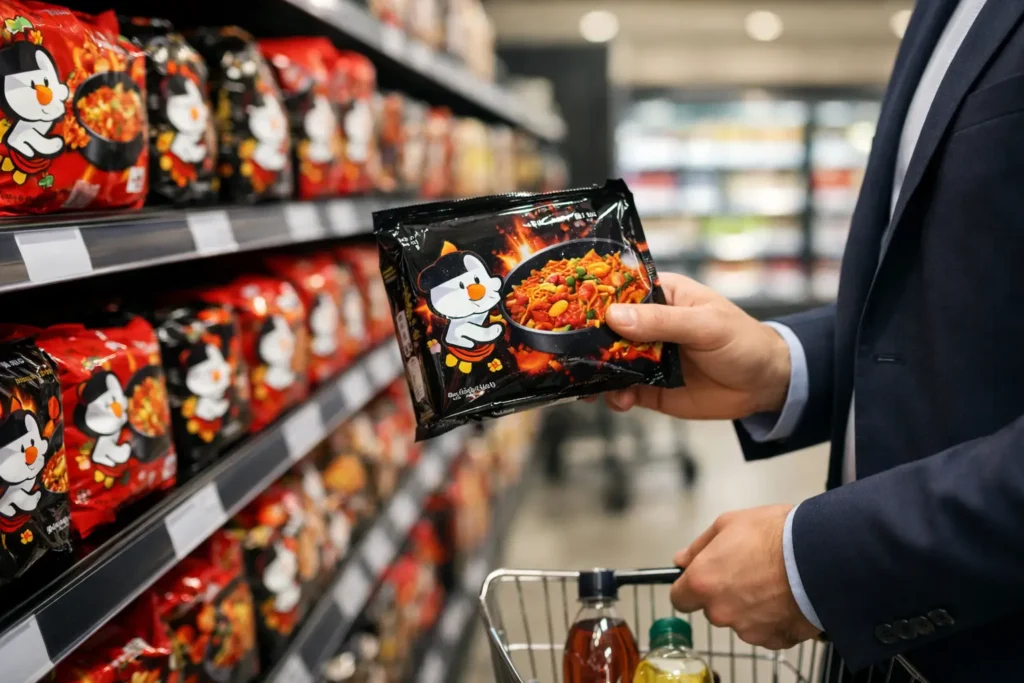
The retailer also changed shelf placement. Instead of spreading the products across a general noodle bay, Buldak was presented as a clearly visible block within the Korean noodle section. Packs were faced consistently, the core SKU received the most space, and complementary Samyang products sat nearby. This made selection easier for established buyers and gave first-time shoppers a clear starting point.
Availability became the main sales lever
The largest improvement did not come from a promotion. It came from reducing out-of-stocks on the top-selling SKU. The buyer set a minimum stock level based on actual weekly movement, delivery lead time and a sensible buffer for demand spikes.
For example, a buyer should not reorder only when the shelf looks low. If an original Buldak line sells at a steady daily rate, the reorder point must cover expected sales during the supplier lead time, plus a safety quantity for weekends, social media activity or local demand changes. This is especially relevant for imported food lines, where replacement stock may require more planning than a domestic short-haul delivery.
The result was a more accurate view of demand. Once the anchor product remained available, repeat purchasers returned to it rather than switching to unrelated noodle brands. Supporting flavours also sold more consistently because customers could see the full range together and buy more than one pack per visit.
Why the range generated repeat purchasing
Buldak has an advantage that many trend-led products do not: it can move from a first-time challenge purchase to a routine cupboard item. That transition depends on how the range is managed.
Initial interest may be driven by heat, online content or recommendation. Repeat sales are driven by taste preference, convenience and confidence that the product will be available next time. A shopper who enjoys the carbonara variation may return weekly. A customer who prefers the original may buy multiple packs when stock is visible and prices are clear. Retailers benefit when these behaviours are supported rather than interrupted.
The buyer in this scenario avoided excessive discounting. Deep promotions can create a short sales spike, but they can also distort reorder data and train customers to wait for reduced prices. Instead, the retailer used visible shelf communication around Korean spicy noodles and occasional multi-pack offers where margin allowed. This protected the perceived value of the line while encouraging basket-building.
For foodservice operators, the same principle works differently. Buldak can be sold as a retail add-on near the till, used in Korean-inspired menu concepts, or offered as a staff-meal and convenience item. However, foodservice buyers should assess preparation capacity, local appetite for spice and packaging suitability before committing to a broad range. High footfall does not automatically mean high repeat demand if customers are unfamiliar with the heat level.
The commercial measures that matter
A useful case study should not reduce performance to a headline sales number. Buyers need measures that show whether growth is profitable and repeatable. The retailer monitored unit sales by SKU, stock cover, out-of-stock days and the share of Buldak within total instant noodle sales.
It also reviewed rate of sale after replenishment. If a product sells quickly only during its first few days on shelf and then slows sharply, the issue may be novelty rather than sustained demand. If the anchor SKU continues to sell at a stable rate across several ordering cycles, it is a stronger candidate for increased facings, wider distribution or larger wholesale orders.
Margin must be assessed alongside velocity. A low-cost noodle that sits for months ties up cash and shelf space. Conversely, a premium, fast-moving Korean noodle can justify its space when it generates repeat purchases and encourages related category sales. The right decision depends on landed cost, local retail price, spoilage risk, delivery frequency and the buyer’s available working capital.
Avoiding the common stocking mistakes
The main risk is assuming that every viral SKU deserves equal depth. A broad Buldak selection can be commercially effective, but only after the core range has proved itself. Buying too many cases of niche variants may reduce cash flexibility and conceal the performance of the products customers genuinely want.
The second risk is treating stock availability as a warehouse matter rather than a sales matter. Empty shelves reduce immediate revenue, but they can also send shoppers elsewhere. Once a customer finds a preferred Buldak product consistently at another retailer, winning that repeat purchase back may require lower prices or more promotional activity.
The third risk is ignoring regional differences. A London specialty supermarket, a university-area convenience retailer and a regional wholesaler may all sell Buldak, but their ideal range and order frequency will differ. Buyers should begin with local demand evidence, then adjust case quantities and assortment using real sales data rather than assumptions.
A practical replenishment approach for wholesale buyers
Start with a core range that includes the recognised original product and a small number of clearly differentiated variants. Give the core SKU the deepest stock position, then review sales weekly during the launch period. Do not wait for a monthly review if a fast seller is already approaching an out-of-stock position.
When the rate of sale is stable, set reorder levels that reflect lead time and delivery reliability. Where demand rises after a local promotion, a new store opening or online attention, increase cover temporarily rather than permanently. This protects availability without leaving the buyer with unnecessary inventory once the spike settles.
A dependable wholesale partner also changes the equation. Product authenticity, clear case information, responsive account support and predictable international fulfilment help buyers plan with confidence. SAMYANG FOODS STORE supports commercial buyers seeking genuine Korean food products in bulk, with the supply focus needed to turn demand into a repeat-order category.
The opportunity is not just one fast-selling pack
The strongest result from this Buldak shelf velocity case study was not a one-week sales surge. It was a more dependable Korean noodle category: a recognised anchor product stayed in stock, supporting variants gave customers reasons to explore, and replenishment decisions were based on movement rather than guesswork.
For buyers, the next useful step is simple: review the days your best-selling Buldak SKU is unavailable, compare that figure with its actual weekly sales, and plan the next order around the demand you are currently losing. Shelf velocity improves when a product people already want is there when they come back for it.
