When a Korean food line starts moving faster than forecast, the pressure lands on sourcing. Buyers looking for ready to eat Korean meals wholesale are rarely searching for novelty alone. They need products that are commercially proven, easy to distribute, and consistent enough to support repeat ordering across retail, wholesale, and foodservice channels.
That is exactly where this category stands out. Ready-to-eat Korean meals sit at the intersection of convenience, authenticity, and strong consumer pull. For commercial buyers, that creates a practical opportunity – a product range that can fit supermarket shelves, online grocery assortments, cash-and-carry formats, and selected foodservice applications without the operational complexity of frozen meal programmes or scratch-made Korean menu development.
Why ready to eat Korean meals wholesale is gaining traction
Consumer interest in Korean food is no longer limited to ramen and snack aisles. The category has matured. Buyers are seeing demand for fuller meal formats, including rice-based dishes, heat-and-serve bowls, curry meals, soup meals, and shelf-stable Korean convenience foods that offer a more complete eating occasion.
From a commercial standpoint, this matters because the category serves more than one need. Retailers gain a fast-growing international food segment with strong visual appeal and clear point of difference. Distributors gain access to products that travel well through ambient supply chains. Foodservice operators gain labour-saving menu support, particularly where speed, consistency, and portion control matter.
There is also a margin conversation here. Products with clear Korean brand identity and recognisable flavour profiles often command stronger perceived value than generic convenience meals. That does not mean every SKU will deliver the same performance, but it does mean the category can support premium positioning when range selection is disciplined.
What buyers should look for in ready to eat Korean meals wholesale
A wholesale programme should be built around sell-through, not just catalogue breadth. Too many buyers over-index on variety and under-estimate what actually drives repeat purchase. In this category, the best-performing lines usually combine approachable formats with clearly Korean flavour credentials.
That means assessing more than price per case. Product format matters. Shelf life matters. Case configuration matters. So does whether the flavour profile is broad enough for mainstream shoppers or more suited to specialist Asian grocery customers. A spicy meal that performs strongly in one market may need balancing with milder options in another.
Packaging is equally important. Buyers should evaluate whether the product is ready for modern retail presentation, whether labelling is export-appropriate, and whether preparation instructions are clear for end users. A strong product can still underperform if the pack does not communicate convenience quickly.
For importers and distributors, consistency across shipments is often the deciding factor. A category built on impulse trial can only become a repeat business if stock flow is dependable. That is why supplier capability matters as much as the product itself.
Product formats that tend to perform well
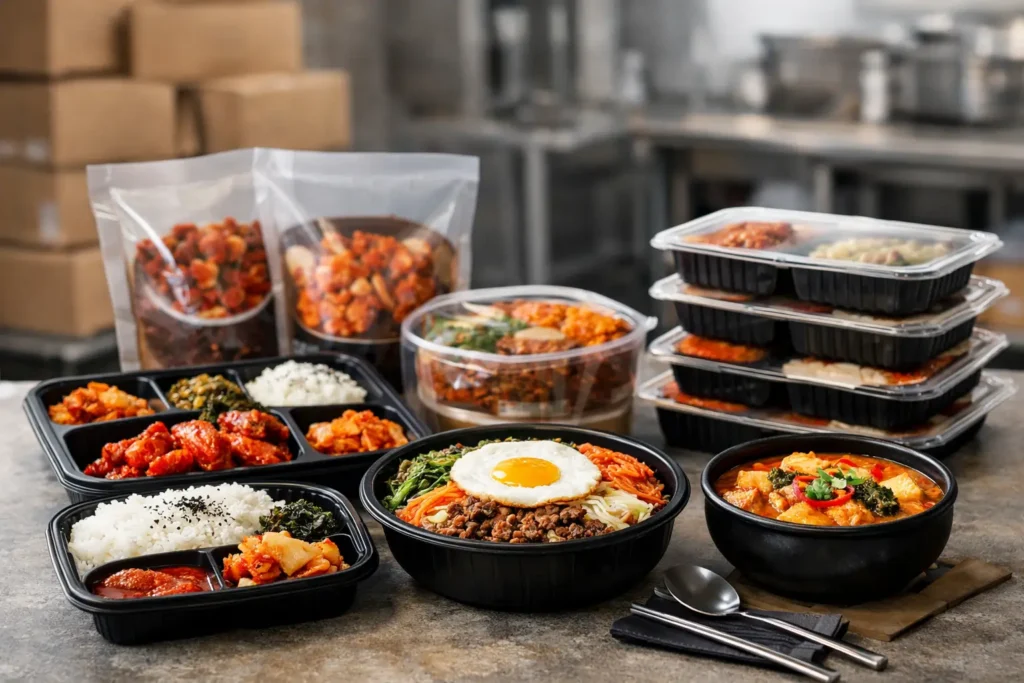
In practical terms, several formats tend to attract sustained demand. Microwaveable rice meals are a strong fit for retail and convenience channels because they are familiar, compact, and easy to merchandise. Korean curry meals and rice bowls work well where customers want a complete meal with minimal preparation.
Soup-based meals and porridge-style products can also perform well, particularly in colder markets or among shoppers looking for comfort-led convenience. The key trade-off is that some products appeal to broad mainstream audiences, while others are better suited to Korean food enthusiasts already seeking authentic flavours.
This is where ranging discipline matters. A buyer building a category from scratch may be better served by starting with proven flavour profiles and high-velocity SKUs before expanding into more niche products.
The operational side matters as much as the product
Wholesale buyers know that product demand means very little if the supply chain cannot support it. Ready-to-eat meals require careful planning around lead times, customs documentation, stock rotation, and replenishment schedules. In cross-border trade, those details are not administrative extras. They directly affect availability, cash flow, and customer confidence.
A dependable wholesale partner should be able to support forecasting, explain case and pallet efficiencies, and provide clarity around export handling. This becomes especially important for businesses expanding Korean food ranges quickly. Demand spikes are useful only if replenishment can keep pace.
There is also a practical question around channel fit. Supermarkets, specialist grocers, distributors, and foodservice operators do not buy in the same way. A serious supplier should understand the difference between stocking for shelf presence, back-of-house convenience, and regional distribution. That commercial understanding often separates a basic exporter from a long-term supply partner.
How to choose the right wholesale supplier
The strongest suppliers do not simply offer Korean products. They offer commercial confidence. For buyers assessing ready to eat Korean meals wholesale, that usually comes down to four things: authenticity, inventory depth, export capability, and account support.
Authenticity matters because Korean food buyers, whether retail or wholesale, are increasingly sensitive to origin and brand credibility. If a product claims Korean appeal but lacks genuine sourcing strength, the market often notices. That can affect both pricing power and customer trust.
Inventory depth matters because one successful SKU tends to pull the rest of the category with it. Once a retailer or distributor sees traction in Korean meals, they often want to extend into noodles, sauces, seasonings, or snacks. Suppliers that can support adjacent categories simplify procurement and create opportunities for larger, more efficient orders.
Export capability matters because delays and documentation problems create hidden cost. Buyers need a partner that understands international movement, from packing and freight coordination to practical fulfilment expectations.
Account support matters because wholesale relationships are built over time. A responsive supplier can help buyers test new lines, manage repeat ordering, and adjust assortments based on sales feedback. That is especially useful in a category where trends can move quickly.
Where ready-to-eat Korean meals fit best
Not every product belongs in every channel. Retail buyers often need shelf-stable meals with strong packaging and fast shopper recognition. Independent grocers may benefit from a tighter but more authentic range, especially where Korean and wider Asian food demand is already established.
Distributors usually need case efficiencies, reliable stock availability, and a product mix that serves mixed customer bases. Foodservice operators, by contrast, may prioritise speed of preparation and consistency over broad shelf appeal. A heat-and-serve Korean meal can work well in cafés, travel hubs, education catering, or workplace foodservice where labour is limited and menu variety matters.
There is a trade-off here. The more mainstream the product, the easier it may be to scale across general retail. The more specialised the flavour or format, the stronger it may perform in specialist channels with informed shoppers. Good wholesale planning accounts for that difference rather than treating all demand as identical.
Building a stronger Korean food range
Ready-to-eat meals perform best when they are not isolated. Buyers often see stronger results when meals sit within a broader Korean food assortment that includes instant noodles, sauces, seasonings, and snacks. This helps create a destination effect rather than a single-SKU purchase.
For wholesalers and retailers, that can improve basket value and category visibility. For distributors, it creates more reasons for customers to consolidate purchasing through one supplier. This is one reason businesses such as SAMYANG FOODS STORE position Korean food as a wholesale ecosystem rather than a one-product trade.
The practical benefit is straightforward. If a buyer can source ready meals alongside recognised Korean pantry lines from the same wholesale partner, ordering becomes simpler, freight planning becomes more efficient, and category expansion becomes easier to manage.
Why timing matters in this category
Korean food demand is no longer a short-lived retail trend, but buyers still need to move with urgency. Once a category gains traction, late entrants often face higher competition, thinner differentiation, and weaker negotiating positions on key lines.
That does not mean rushing into undisciplined buying. It means treating category entry as a strategic sourcing decision. The best time to establish a dependable supply line is before demand peaks beyond your current inventory model.
For commercial buyers, the real opportunity in ready to eat Korean meals wholesale is not simply adding another imported product. It is securing a category with repeat potential, strong merchandising value, and broad channel relevance – provided the supplier can match the pace of the market.
A sensible next step is to assess your customer base, choose a focused starting range, and work with a wholesale partner that can support both immediate volume and long-term growth.

Pingback: Samyang Wholesale vs Local Distributors – SAMYANG FOODS STORE
Pingback: Korean Snacks Versus Japanese Snacks – SAMYANG FOODS STORE
Pingback: Bulk Food Import Documentation Guide - SAMYANG FOODS STORE