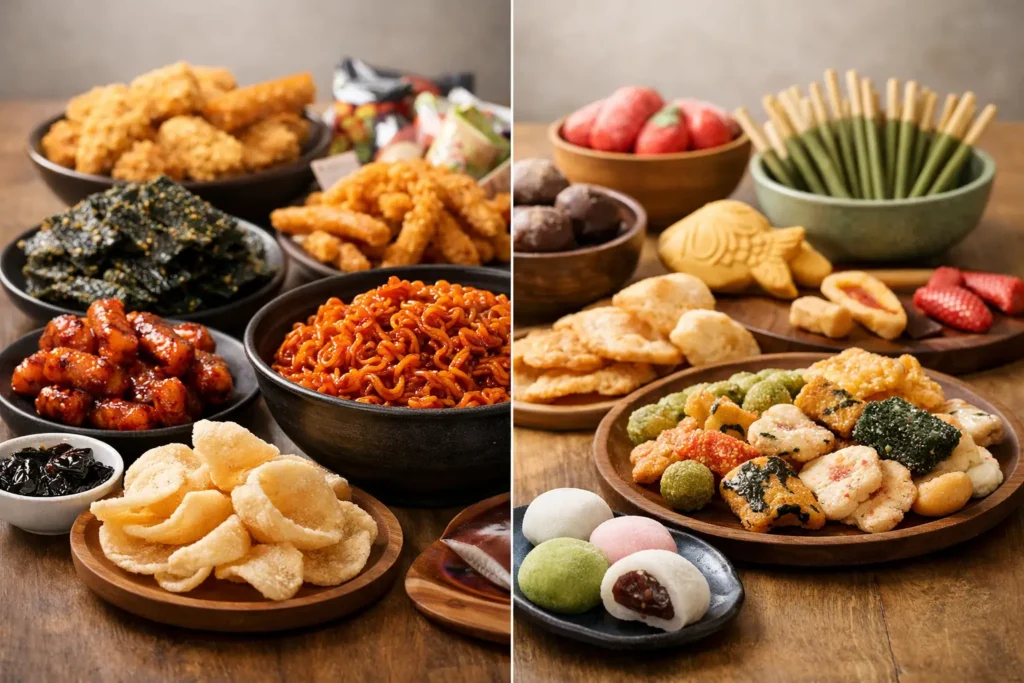
A buyer choosing between Korean snacks versus Japanese snacks is not deciding which country makes better products. The real question is which snack profile fits your customer base, margin target and replenishment model. For wholesalers, retailers and foodservice operators, that distinction matters because snack demand is driven as much by repeat purchase behaviour as by novelty.
Both categories are established, recognisable and commercially viable. Yet they perform differently on shelf. Korean snacks often win on bold flavour, trend momentum and social media visibility. Japanese snacks tend to perform strongly on refinement, gifting appeal and broad consumer curiosity. If you are building an Asian snack range for resale, the right mix depends on where you expect volume, where you expect premium positioning and how quickly you need products to convert.
Korean snacks versus Japanese snacks in market terms
From a commercial perspective, Korean snacks are typically easier to position around excitement. Spicy, sweet-spicy, savoury and highly seasoned products have become familiar to mainstream shoppers, not just specialist Asian food customers. Korean food culture has moved into the centre of global demand through instant noodles, hot chicken flavours, street food formats and convenience products that encourage repeat purchasing.
Japanese snacks often enter the basket differently. They are frequently associated with craftsmanship, lighter textures, seasonal flavours and packaging that feels giftable or collectable. That can support premium pricing, but it can also mean a slightly slower route to repeat purchase if the product is bought once for curiosity rather than regularly for craving.
Neither route is inherently stronger. It depends on your channel. A supermarket group looking for dependable turnover may favour Korean snack lines with stronger flavour recognition and clearer trial-to-repeat potential. A premium retailer or gift-led store may find Japanese snacks easier to merchandise around presentation and perceived quality.
Flavour profile and repeat purchase potential
The clearest difference is flavour intensity. Korean snacks tend to lead with impact. Chilli, gochujang-inspired sweetness, soy-garlic depth, cheese powder, honey butter seasoning and roasted seaweed flavours are built to be memorable. Many Korean snack products are designed around strong snacking cravings, which can make them commercially effective in impulse channels and convenience-led retail.
That strength matters for repeat sales. A shopper who actively wants a spicy corn snack, seasoned seaweed crisp or bold potato snack is easier to bring back than a shopper who bought a novelty item once. Korean snacks often benefit from exactly that sort of direct craving loop.
Japanese snacks are often more restrained, though not always mild. There is usually greater emphasis on balance, texture and distinct regional or seasonal flavour variations. That can create a more sophisticated category, but for some mass-market environments it requires more customer education. If the shopper does not immediately understand the flavour proposition, sell-through can rely more heavily on merchandising.
For commercial buyers, this creates a practical split. Korean snacks are often easier to place where quick decision-making drives purchases. Japanese snacks can reward a more curated approach, particularly in stores where discovery is part of the customer experience.
Format, merchandising and shelf behaviour
Format plays a major role in wholesale performance. Korean snacks are particularly strong in categories that cross over with convenience and mainstream snacking habits – crisps, puffed snacks, roasted seaweed, coated nuts, crackers and snackable noodle-related products. These formats are familiar, easy to explain and easy to place alongside existing savoury ranges.
Japanese snacks can be highly diverse, but they often include more confectionery-driven or niche textural formats, from rice crackers to filled biscuits and premium gummies. That diversity is attractive, though it can create more fragmented demand if the range is too broad without a clear category strategy.
For retailers, Korean snack ranges often lend themselves to tighter SKU selection with faster turnover. For importers and distributors, that can simplify forecasting. A focused range of proven Korean flavours may generate stronger basket consistency than a wide assortment of lower-volume experimental lines.
That does not mean Japanese snacks should be treated as secondary. It means they are often strongest when curated with purpose. If the goal is premium assortment, gifting, travel retail or destination-led merchandising, Japanese snacks can perform very well. If the goal is high-frequency replenishment in supermarkets, convenience and mainstream Asian aisles, Korean snacks often have the clearer operational case.
Consumer trend strength and cultural momentum
Korean packaged food has benefited from unusually strong crossover into global mainstream demand. Consumers who first entered the category through ramen, especially spicy Korean instant noodles, often move naturally into other snack products. That creates halo demand across the wider Korean pantry and snack segment.
This is where Korean snacks have a strategic advantage. They are rarely sold in isolation. They sit within a broader Korean food wave that includes noodles, sauces, seasonings and ready-to-eat meal solutions. For a commercial buyer, that means snacks can be part of a larger Korean food programme rather than a stand-alone experiment.
Japanese snacks continue to enjoy strong brand recognition and cultural appeal, especially among consumers already engaged with Japanese confectionery, anime-adjacent retail trends and premium imported goods. But in many markets, Korean snacks currently benefit from stronger urgency. They feel current, not just interesting.
That difference influences reorder confidence. Retailers and wholesalers are more likely to scale categories that attach to active, visible demand. Trend momentum does not replace sound buying decisions, but it does reduce the cost of customer education.
Pricing, margin and wholesale practicality
Buyers should also consider how each category behaves commercially once landed cost, shelf price and velocity are taken into account. Korean snacks often suit a margin structure built around accessible retail pricing and steady movement. Products with familiar savoury formats and bold flavours can justify reliable reorder cycles without depending on premium positioning.
Japanese snacks can support higher perceived value, particularly in premium retail. However, premium perception only helps if the end consumer is willing to pay repeatedly. If your channel is price-sensitive, heavily premium-priced imported snacks may create slower movement, tying up shelf space and working capital.
This is why product selection matters more than category reputation. A strong Korean snack range can combine trend demand with practical price architecture. For wholesalers, that usually supports better volume forecasting. For retailers, it supports shelf efficiency. For foodservice operators, selected Korean snack items can also work as add-on retail products or menu-adjacent grab-and-go lines.
Supply reliability is just as important as demand. Imported snacks only become viable long-term when sourcing is consistent, lead times are managed and replenishment is predictable. Buyers comparing categories should not only ask what will sell, but also what can be scaled without disruption.
Where Korean snacks usually outperform
Korean snacks usually have the edge in channels where flavour-led impulse buying drives results. Convenience stores, supermarket world food aisles, student-oriented retail, Asian grocery chains and foodservice locations with takeaway traffic often respond well to spicy and highly seasoned products. These environments reward familiarity, strong visual packaging and products that trigger immediate trial.
Korean snacks are also easier to cross-sell with adjacent Korean staples. If a customer is already buying instant noodles, tteokbokki sauce, seaweed or seasoning products, adding Korean savoury snacks feels like a logical extension. That broader category ecosystem can increase total basket value.
For buyers working with a wholesale-focused supplier such as SAMYANG FOODS STORE, that ecosystem matters. Sourcing snacks alongside proven Korean pantry categories can strengthen assortment planning and reduce procurement friction.
When Japanese snacks may be the better fit
Japanese snacks may be the better fit if your business relies on presentation, premium discovery or gift-led purchasing. Department-store style retail, curated import boutiques and channels serving tourists or collectors can benefit from the design and perceived craftsmanship often associated with Japanese snack products.
They may also work well where your customers actively seek limited-edition flavours and browse slowly rather than buying quickly. In these settings, lower velocity can still be acceptable if margins are strong and the category enhances brand image.
The trade-off is that this model usually requires more deliberate merchandising. You are selling a more curated experience, not just a snack craving.
How commercial buyers should decide
The best buying strategy is rarely Korean or Japanese. It is usually about role allocation within your assortment. Korean snacks are often the volume driver – bold, accessible and well suited to repeat purchase. Japanese snacks can serve as a premium or discovery layer – useful for range depth and customer interest.
If you are entering the category for the first time, Korean snacks often provide the faster commercial entry point. They align well with current demand patterns and sit naturally beside other high-performing Korean packaged foods. If your range is already established and your customers expect more breadth, Japanese snacks can add differentiation.
A sensible buyer asks three questions. Which products are easiest for customers to understand at a glance? Which items are most likely to be bought again within weeks, not months? Which supply partner can support those lines consistently at scale?
Answer those clearly and the category becomes much easier to build.
The strongest snack range is the one that fits your customers, moves reliably and can be replenished without drama. That is where smart sourcing turns trend interest into repeat business.
