A fast-selling Korean line can turn into a sourcing problem the moment demand spikes. That is usually when the question of Samyang wholesale vs local distributors stops being theoretical and becomes a commercial decision with real impact on margin, availability and customer retention.
For buyers stocking Samyang noodles, sauces and related Korean grocery lines, there is no single right model for every market. The better choice depends on order volume, stock planning, import capability, cash flow and how much control you want over your supply chain. Some businesses need the speed and convenience of a local distributor. Others need the scale, pricing structure and product access that come with wholesale purchasing closer to source.
Samyang wholesale vs local distributors: what changes in practice?
At a glance, both routes can put the same brand on your shelves or into your foodservice operation. The difference is in how the supply relationship works behind the scenes.
Buying through a local distributor usually means purchasing stock that has already been imported, stored and prepared for domestic resale. That often reduces operational friction. You can place smaller orders, replenish quickly and avoid managing as much cross-border complexity yourself. For businesses testing demand or serving a limited regional footprint, that convenience can matter.
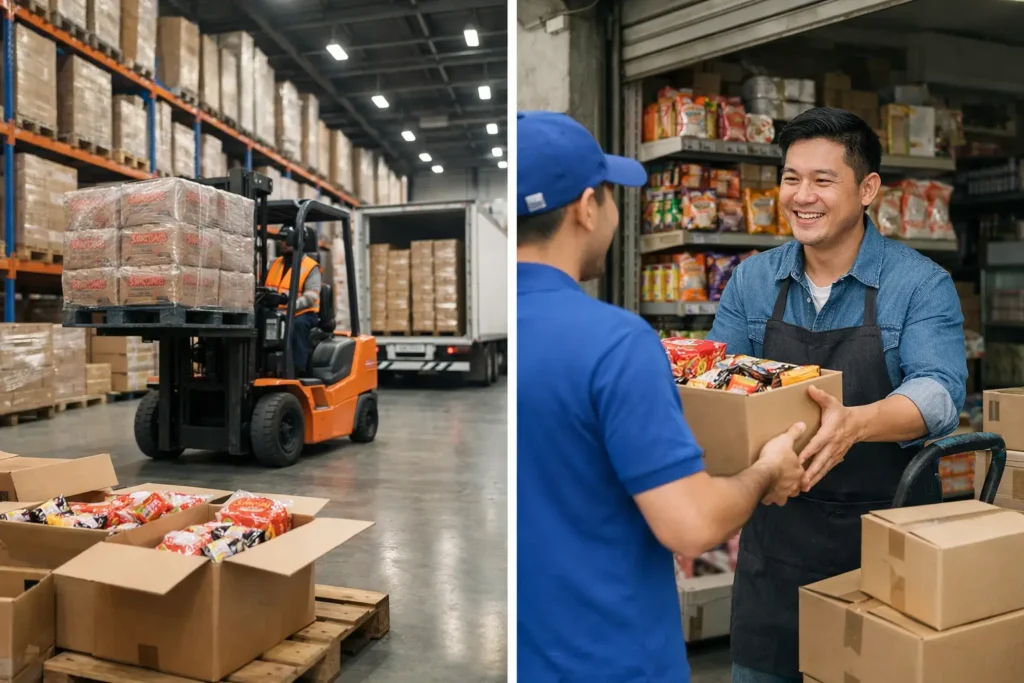
Working through a wholesale export partner is a different commercial model. It is built for bulk procurement, broader product access and long-term supply planning. Instead of buying whatever is already sitting in a local warehouse, you are often planning container space, lead times, product mix and repeat ordering in a more strategic way. That tends to suit importers, chain buyers, established distributors and foodservice groups that need consistency at scale.
The real comparison is not simply local versus overseas. It is convenience versus control, smaller commitments versus stronger buying power, and short-term ease versus long-term supply advantage.
Price is only one part of the margin question
Many buyers start with unit cost, which is sensible, but incomplete. A local distributor may quote a higher landed price because their cost includes import handling, storage, domestic distribution and their own margin. In exchange, you may avoid committing to a larger shipment and you may reduce internal workload.
Wholesale sourcing can improve buying economics, especially when volumes are strong and repeatable. The direct pricing structure is often more favourable for businesses that can buy in bulk and manage inventory efficiently. If Samyang products are established sellers in your stores or channels, lower acquisition cost can create more room for promotional pricing, stronger resale margin or a more competitive shelf position.
That said, the cheaper quote on paper is not always the better deal. If you overbuy, tie up cash in slow-moving stock or underestimate freight and customs costs, your margin can narrow quickly. The right calculation includes minimum order quantities, shipping mode, duty exposure, warehousing capacity and sales velocity across your own customer base.
For smaller buyers, a local distributor can sometimes protect margin by reducing risk, even if the unit price is higher. For larger buyers, wholesale usually becomes more compelling once order frequency and volume justify a more structured import programme.
Stock reliability often matters more than headline price
If you are sourcing trend-led Korean food lines, availability is rarely a minor issue. A promotion, a social media spike or seasonal demand can empty shelves quickly. When that happens, the most expensive product is often the one you cannot get.
Local distributors can be useful when you need stock immediately and they happen to hold the exact SKU and pack format you require. The weakness is that your access is limited by their local inventory position, their allocation policy and their confidence in carrying deep stock. If they run short, you are competing with every other domestic customer drawing from the same pool.
A wholesale partner with direct sourcing capabilities is usually better positioned for planned replenishment and broader volume support. That matters when Samyang is a recurring line in your assortment rather than a one-off opportunity. Buyers with forecastable demand generally benefit from booking stock earlier, aligning shipments to sales cycles and building a more deliberate replenishment rhythm.
Reliability is not only about whether goods exist. It is also about whether your supplier can communicate lead times clearly, confirm packing details accurately and support repeat orders without constant changes. Commercial buyers do not need surprises dressed up as flexibility. They need dependable execution.
Product range and authenticity are not minor details
This is where the gap can widen. A local distributor may carry only the most familiar Samyang items, usually the highest-turning flavours and pack sizes. That can be enough if your strategy is built around a narrow range of proven sellers. It is less helpful if you want to expand into adjacent categories, test new variants or build a fuller Korean food programme around a core noodle line.
Wholesale sourcing often gives buyers stronger access to branded depth. That can include different noodle varieties, sauces, seasonings, snacks and ready-to-eat products that support a broader basket. For wholesalers and retailers, range depth can increase average order value. For foodservice operators, it can simplify procurement by consolidating multiple Korean pantry categories through one trade relationship.
Authenticity also matters commercially. Buyers serving consumers who know Korean brands well cannot afford vague sourcing or uncertain product history. Packaging accuracy, proper labelling support and confidence in product origin all affect trust at shelf level. In export trade, those details are part of the offer, not an afterthought.
Lead times, logistics and operational effort
The case for local distribution is strongest when speed is non-negotiable. If you need a pallet next week, local stock can be the practical answer. It reduces transit time and may allow more reactive purchasing. That is useful for independent retailers, smaller supermarket groups and operators managing limited backroom space.
But short lead times are only one part of logistics planning. If you are buying repeatedly and at scale, predictable international shipping can be more valuable than ad hoc domestic replenishment. A reliable wholesale partner should be able to support documentation, shipment planning and account coordination in a way that makes cross-border procurement manageable rather than burdensome.
This is often where experienced buyers separate true supply partners from simple sellers. You are not only buying product. You are buying execution across ordering, packing, freight coordination and delivery scheduling. For businesses importing Korean food as a growth category, logistics capability can influence profitability as much as product price.
A supplier such as SAMYANG FOODS STORE is built around that wholesale reality – bulk supply, authentic product access and cross-border operational support for repeat commercial buyers. For importers and distributors, that model usually aligns better with scale than relying entirely on fragmented local stock.
When local distributors make the most sense
There are clear situations where local distributors are the better fit. If you are entering the category for the first time, want to test customer response, or do not yet have enough throughput to justify larger imports, buying locally can be the lower-risk move. It can also suit businesses that lack warehousing, import processes or the internal resource to manage larger procurement cycles.
Local sourcing may also work well when your need is tactical rather than strategic. Perhaps you need a short-term fill-in order, a quick top-up before a promotion, or a limited quantity for a specific customer account. In those cases, convenience outweighs optimisation.
The limitation appears when the category starts to grow. Once Samyang becomes a dependable volume line, the local route can become more expensive, less flexible and more vulnerable to shortages than it first seemed.
When Samyang wholesale is the stronger route
Wholesale is usually the better option when demand is established, planning horizons are longer and supply continuity matters. If you are a distributor supplying retail accounts, a supermarket buyer with multiple sites, or an importer building a Korean range with repeat turnover, wholesale offers stronger foundations.
It also suits buyers who want more control over assortment and better visibility over future supply. Instead of taking what is available domestically, you can align purchasing with forecasted demand, promotional calendars and category expansion plans. That is a better position for margin management and service reliability.
The buyers who gain most from wholesale are usually not chasing the cheapest one-off order. They are building a dependable supply structure that supports growth.
The right decision depends on where your business is now
The most useful way to approach Samyang wholesale vs local distributors is to match the sourcing model to your current commercial stage. If your volume is modest and your need is immediate, local distribution can be sensible. If your business is scaling, your customers expect continuity and your Korean food range is becoming strategically important, wholesale is likely to offer better long-term value.
A serious buyer should ask a few practical questions. Is your demand proven enough to support bulk purchasing? Can your operation handle planned lead times? Do you need a wider Samyang range than local stockists typically hold? Are you trying to protect margin over repeat orders, not just one shipment? The answers usually point clearly towards the right model.
The strongest procurement decisions are rarely about convenience alone. They are about choosing the supply route that leaves your business better positioned six months from now, not just better stocked next week.

Pingback: Top Samyang Flavours for Resale – SAMYANG FOODS STORE