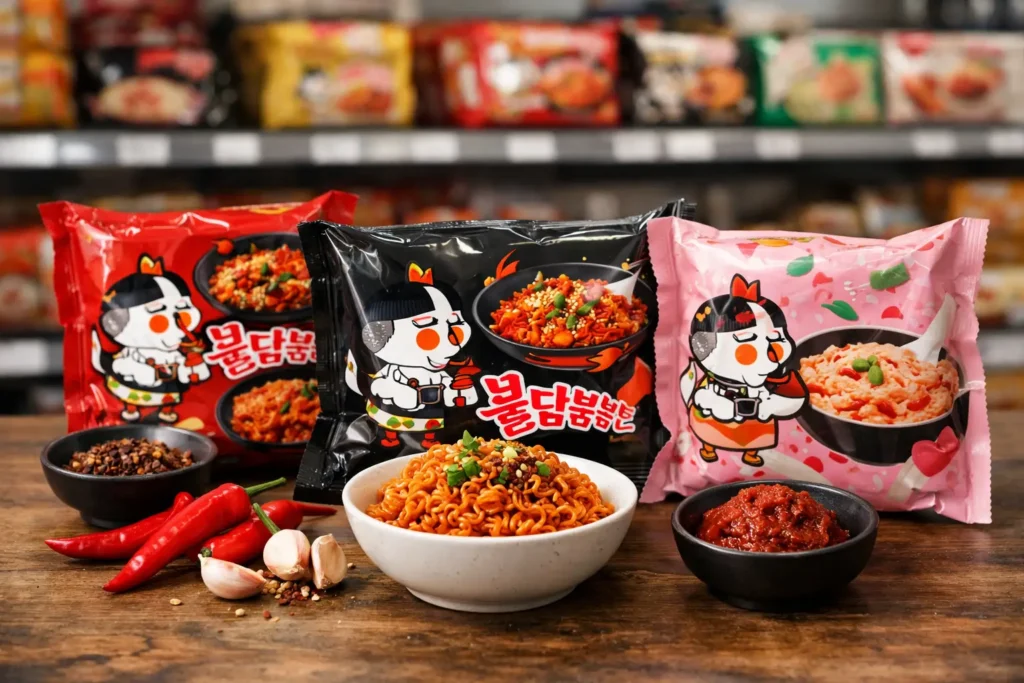
If Buldak is moving quickly on your shelves one month and leaving gaps the next, the issue is rarely demand. It is usually range planning. Knowing how to stock Buldak flavours means matching proven best-sellers with the right depth of inventory, then supporting that range with enough variety to keep repeat buyers interested without tying up capital in slow-moving lines.
For commercial buyers, Buldak is not a novelty purchase any more. It sits in a stronger category position than many imported noodle lines because it combines brand recognition, social media demand, repeat purchase behaviour and cross-channel appeal. Supermarkets, Asian grocers, distributors and foodservice operators all see demand, but the right stock profile differs depending on who the end customer is.
How to stock Buldak flavours for commercial demand
The first decision is not which flavour is your personal favourite. It is which flavours deliver consistent turnover in your channel. In most markets, core spicy variants do the heavy lifting. Carbonara, Hot Chicken, 2x Spicy and original Hot Chicken tend to attract the broadest and most reliable demand because they already have consumer awareness. These are usually the lines that justify deeper stock positions.
Then there are support flavours. Cheese, Kimchi, Curry, Jjajang, Habanero Lime and similar variants can strengthen the range, but they should usually be stocked with more caution until your sales data proves otherwise. For a supermarket or retail wholesaler, these flavours add shelf interest and encourage basket growth. For a distributor selling onward to smaller shops, they create a more complete catalogue offer. For foodservice, they can support limited-time dishes or viral menu items, but only if kitchen teams actually have a use for them.
The practical point is simple. Your range should be led by velocity, not by novelty. A wide range can help you win customers, but overextending into too many slow lines weakens cash flow and creates expiry risk.
Start with a core-and-test flavour mix
A reliable Buldak assortment usually works best when split into two groups. The first is the core range – flavours with established demand and predictable reorder frequency. The second is the test range – flavours stocked in lighter quantities to measure traction in your market.
For most buyers, the core range should take the majority of inventory spend. If you are opening a new market or adding Buldak for the first time, it is often smarter to begin with a narrower mix and stronger depth than a broad mix with weak availability. A missing best-seller loses sales immediately. A missing niche flavour rarely does.
A useful approach is to build your opening stock around three to five high-recognition flavours, then layer in two to four secondary options. That gives enough variety for the shelf, the catalogue or the menu discussion without turning your stock room into a speculation exercise.
What counts as a best-seller can still vary by region. Carbonara may outperform classic spicy in one retail environment because it appeals to a broader shopper base. In another market, 2x Spicy may lead because the challenge factor is driving demand. This is why initial sell-through data matters more than assumptions.
Retail, wholesale and foodservice need different mixes
Retailers typically need a visible flavour spread because shoppers compare directly on shelf. They also benefit from stocking recognisable best-sellers in greater volume, especially where Korean food already has good category awareness. Convenience-led shops may prefer a tighter range with fast rotation, while larger supermarkets can carry more secondary flavours if shelf space allows.
Wholesalers and distributors need a slightly different balance. Their customer base may include small grocers, online resellers and cash-and-carry buyers, so assortment breadth can help secure accounts. Even so, the same rule applies: depth should stay with the core flavours. Catalogue breadth should not come at the expense of supply consistency on the top lines.
Foodservice operators should be stricter. If the product is used as a menu ingredient, promotional item or staff meal line, only stock flavours with a defined operational purpose. A broad retail-style flavour set often makes less sense in professional kitchens unless there is proven menu demand.
Pack format matters as much as flavour choice
When buyers think about how to stock Buldak flavours, they often focus only on flavour names. That misses an important commercial factor: pack format. Single packs, multi-packs and case quantities serve different sales models.
Single packs are useful for impulse purchase, trial and convenience retail. They let shoppers experiment with different flavours and can support stronger margins per unit. Multi-packs make more sense where the consumer is already familiar with the brand and wants value. They can work especially well in supermarkets, club-style formats and larger ethnic grocery outlets.
At wholesale level, case configuration affects storage efficiency, replenishment rhythm and account servicing. If your downstream buyers prefer mixed flavour purchasing in smaller quantities, a stock plan that is too heavily weighted towards large-volume single-SKU commitments can create friction. On the other hand, if your retail partners want steady access to proven flavours, deeper case holdings on those lines reduce the risk of missed sales.
The right answer depends on your customer profile, but the principle is consistent: stock the format that matches how your buyers actually sell.
Plan inventory around turnover, not enthusiasm
Strong demand does not remove the need for disciplined inventory control. Buldak is a fast-moving category in many markets, but buying too broadly or too early can still create pressure on working capital and storage.
A sound approach is to set stock depth according to sales velocity, lead time and reorder frequency. Fast lines need enough cover to absorb promotion periods, social spikes and shipping variation. Slower lines need tighter controls and clearer reorder triggers. If you are importing across borders, build in realistic lead-time buffers rather than relying on best-case transit assumptions.
This is where a dependable supply partner matters. Direct sourcing, predictable fulfilment and responsive account support reduce the amount of safety stock you need to hold. That improves cash efficiency without exposing your business to avoidable stockouts. For buyers managing multiple Korean pantry categories, a supplier that can coordinate broader procurement also simplifies planning.
Watch expiry and shelf allocation closely
Not every Buldak flavour deserves equal shelf space. Give more facings to top sellers and reduce exposure on experimental lines unless they prove their pace. This sounds obvious, yet many buyers still let shelf presentation drift into a display of variety rather than a display of what actually sells.
Expiry management is just as important. Imported noodles generally offer workable shelf life, but the risk comes from overestimating demand for niche variants. Keep the range dynamic. If one flavour underperforms over several cycles, reduce the commitment or replace it with a stronger line. Good buying is not about stocking everything. It is about stocking what earns its place.
Use sales data to refine your flavour range
The first order is a market entry decision. The second and third orders are where the real strategy starts. Once you have sell-through data, reorder patterns and customer feedback, you can shift from assumption to precision.
Look at rate of sale by flavour, not just total category volume. A line that sells steadily every week is often more valuable than a flavour that spikes once and then stalls. Also compare performance by customer type. A flavour that is average in supermarket may be strong in specialist grocery, while one that works in retail may be irrelevant for foodservice.
Promotional performance matters too. If a flavour only moves when discounted, its long-term value may be weaker than the headline sales suggest. By contrast, a line that sustains repeat orders at standard pricing is a stronger candidate for deeper stock.
For larger buyers, it is worth reviewing the Buldak range as part of a broader Korean food strategy. Noodles often drive traffic, but sauces, seasonings and snack adjacencies can increase basket value. A wholesale partner with category breadth can help align these decisions more effectively than managing each line in isolation.
Work with a supplier that supports repeat ordering
The commercial opportunity in Buldak is not a one-off launch. It is repeat ordering. That only happens when stock is authentic, replenishment is dependable and logistics are managed with the discipline international buyers expect.
When evaluating suppliers, look beyond headline pricing. Ask whether the range is sourced consistently, whether bulk quantities are realistic, whether shipping support matches your market, and whether the account team understands the pressure points of import, retail replenishment and wholesale fulfilment. A trusted global partner should help you maintain availability, not leave you solving avoidable supply gaps.
For businesses scaling Korean food ranges, this becomes a competitive advantage. SAMYANG FOODS STORE is positioned for that type of buyer – one that values authentic product access, bulk-only expertise and reliable cross-border execution.
How to stock Buldak flavours well comes down to discipline. Keep your core lines deep, test secondary flavours intelligently, match pack formats to your channel and let sales data decide what stays. The businesses that treat Buldak as a managed growth category, rather than a trend item, are usually the ones that keep reordering with confidence.

Pingback: Which Korean Noodles Sell Year Round? – SAMYANG FOODS STORE
Pingback: Why Wholesale Korean Pantry Products Sell – SAMYANG FOODS STORE
Pingback: Which Ramen Sells Fastest in Wholesale? - SAMYANG FOODS STORE
Pingback: 8 Best Korean Ramen Brands for Retailers - SAMYANG FOODS STORE