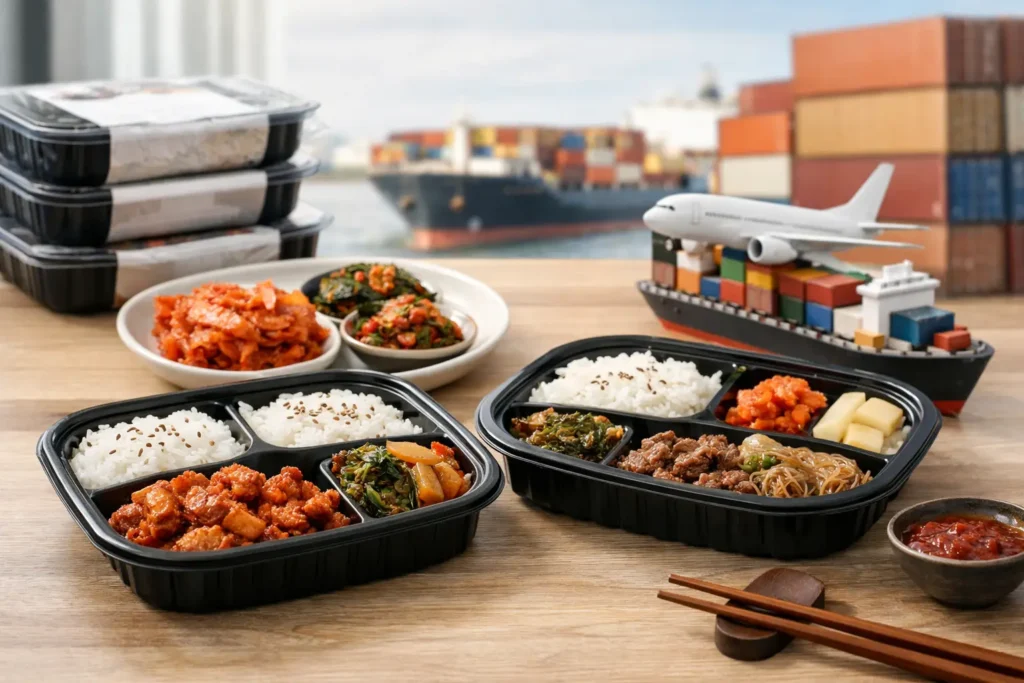
If you are assessing how to import Korean ready meals, the commercial question is not simply how to get stock from Korea to your warehouse. It is how to build a repeatable supply line that meets local import rules, lands at the right cost, and gives your customers products they will actually reorder. For wholesalers, supermarket buyers and foodservice operators, that difference matters. A fast first shipment is easy. A stable category that keeps selling is the real objective.
Korean ready meals sit in a strong position because they meet two forms of demand at once. Buyers want authentic Korean food with proven consumer recognition, and end customers want convenience. That makes the category attractive across Asian grocers, mainstream retail, campus retail, travel retail and selected foodservice channels. But it also means buyers need to think carefully about shelf life, product format, regulatory compliance and supplier reliability before placing volume orders.
How to import Korean ready meals without costly mistakes
The first step is to define what you mean by ready meals. In trade, this category can include shelf-stable rice bowls, microwaveable meals, retort pouches, cup meals, instant soup meals and prepared meal kits that only require heating or very limited preparation. Each format brings different storage, freight and compliance considerations. Shelf-stable products are usually easier to scale internationally than chilled or frozen lines, especially for first-time importers.
That is why experienced buyers start with range selection, not freight. If a product has short shelf life, fragile packaging or uncertain classification, the landed model becomes harder to control. If the product is ambient, export-ready and built for retail turnover, importing becomes far more straightforward.
A practical starting point is to shortlist products based on four commercial filters: proven demand, acceptable shelf life on arrival, clear ingredient documentation and suitable labelling potential for your market. Trend value matters, but not on its own. A product may be popular online and still be a poor wholesale item if the packaging is difficult to localise or if the shelf life left after transit is too tight for your distribution cycle.
Start with the right supplier, not just the lowest quote
A dependable supplier does more than offer a catalogue. In this category, the supplier should be able to confirm product authenticity, production source, carton configurations, lead times, shelf-life windows and export document readiness. That reduces risk before the shipment is even booked.
For commercial buyers, supplier evaluation should focus on whether the business can support repeat orders at scale. Ask how stock is allocated, whether mixed containers are possible, how often production runs change, and what level of support is available if customs or document checks delay clearance. Cheap pricing loses value quickly if the shipment arrives late, incomplete or unsupported.
This is where a wholesale-focused partner has a clear advantage. Businesses such as SAMYANG FOODS STORE are structured around bulk ordering, international fulfilment and ongoing account support rather than one-off consumer sales. That matters when you are building a category, not testing a novelty line.
Documentation and compliance come before shipment
Importers sometimes treat paperwork as an admin task to handle after purchase. In reality, documentation should shape the purchase itself. Before goods are dispatched, you need to confirm what your local authority or port agent will require for packaged food imports. Requirements vary by market, but the same principle applies everywhere: if the product file is weak, the shipment becomes vulnerable.
At minimum, buyers should expect to review the commercial invoice, packing list, product specifications, ingredient breakdown, allergen declarations, shelf-life details and country of origin confirmation. Depending on the market, you may also need certificates, translated labels, nutrition panels or product registration support. If the product contains meat, dairy or other sensitive ingredients, the checks may be stricter and the import route may become more complex.
This is why many buyers begin with non-chilled, shelf-stable Korean ready meals that have relatively clear packaged food pathways. They are often easier to handle than frozen meals or products with more restricted ingredients. The right product mix can reduce friction before your first container ever leaves port.
Labelling can slow down good products
One of the most common reasons for delay is not the product itself but the label. Korean domestic packaging may not satisfy local retail requirements in the UK or other target markets. If the label lacks mandatory information in the required format, you may need over-stickers, relabelling at destination or revised packaging at source.
That affects both cost and speed. Over-sticker solutions can work well for wholesale launches, but they need to be accurate and professionally managed. If you are supplying supermarkets or larger retail accounts, they may have stricter expectations around barcode readiness, case labelling, traceability and outer carton standards.
The practical approach is to review label compliance at quote stage, not after payment. Ask for artwork, product photos and specification sheets early. It is far better to reject a strong-looking line at the desk than discover a labelling issue after the goods are on the water.
Freight mode changes your margin
When buyers ask how to import Korean ready meals, they often focus on customs first. Freight deserves equal attention because it shapes margin, stock risk and replenishment speed. Air freight may be suitable for urgent launches, low-volume tests or back-orders on fast-selling SKUs, but for regular wholesale programmes, sea freight is usually the more sustainable option on cost.
That said, sea freight only works well if the lead time fits your stock planning. Korean ready meals with strong demand can move quickly once listed, so under-ordering can be as costly as over-ordering. If you run out early, your customers may switch to substitute products and your launch momentum disappears.
A useful discipline is to model landed cost with several order sizes rather than one. Compare pallet-level tests, less-than-container shipments and full-container scenarios. Then pressure-test the numbers against expected sell-through, trade margins, warehousing costs and promotional plans. A category that looks attractive on unit cost alone may be less appealing once handling and compliance costs are added.
Build the range for resale, not just for trend appeal
A good Korean ready meals range usually needs a balance of recognisable entry products and more differentiated lines. If every SKU is highly niche, your buyer education burden rises. If every SKU is too generic, the range loses the Korean authenticity that attracts shoppers in the first place.
For supermarket and wholesale channels, the strongest starting range is often compact. A focused launch with a few dependable SKUs is easier to replenish, merchandise and monitor than a broad range with uncertain velocity. Ready meals work best when the range tells a clear story: convenient Korean meals, trusted flavour profiles, shelf-stable practicality and visible brand credibility.
Foodservice buyers may think differently. In that channel, portion suitability, preparation speed and back-of-house storage efficiency can matter more than shelf design. The same product that performs well in a retail aisle may not be ideal for cafés, canteens or travel foodservice. Import strategy should follow channel strategy.
Forecasting matters more than first order size
Importing successfully is less about placing a first order and more about managing the second and third. Ready meals can perform sharply if consumer demand is already primed by broader interest in Korean cuisine, but that same demand can create forecasting errors. If a line gains traction on social media or through local retail promotion, replenishment pressure arrives quickly.
That is why buyers should align purchasing with realistic reorder windows. Ask your supplier about production frequency, minimum order quantities and whether fast-moving SKUs have priority allocation. A supplier who can support continuity is usually worth more than one offering a lower opening price with weak replenishment discipline.
Commercially, the goal is simple: avoid dead stock, but also avoid losing shelf space because supply is inconsistent. Retailers and distributors value categories they can rely on. Reliability is often what turns a trial listing into a permanent one.
How to import Korean ready meals for long-term growth
The businesses that do this well treat importing as a category-building exercise. They do not buy on excitement alone, and they do not leave logistics, compliance and replenishment to chance. They choose products that can travel well, clear cleanly, fit the target channel and support repeat purchasing.
If you are entering the category for the first time, begin with ambient ready meals that offer clear documentation, workable label adaptation and enough remaining shelf life to support wholesale distribution. Pair that with a supplier who understands export execution, not just product supply. That combination gives you a far stronger base than chasing the widest catalogue or the lowest headline price.
Korean ready meals can become a serious commercial category when the operational side is handled properly. The opportunity is real, but disciplined sourcing is what turns market demand into dependable revenue. Start with products you can clear, store and resell with confidence, and the rest of the import process becomes far easier to scale.
