If you are planning to stock Buldak noodles, Samyang ramen or Korean pantry lines in volume, the difference between Samyang wholesale vs retail is not a small pricing detail. It shapes your margin, your stock reliability, your shipping model and, ultimately, whether the product works as a repeatable commercial line or a one-off purchase.
For business buyers, retail is useful for testing consumer interest or checking pack formats. It is not built for scale. Wholesale is built for procurement teams, distributors, supermarkets and foodservice operators that need consistent supply, trade pricing and a supplier that can support repeat orders across borders.
What Samyang wholesale vs retail really means
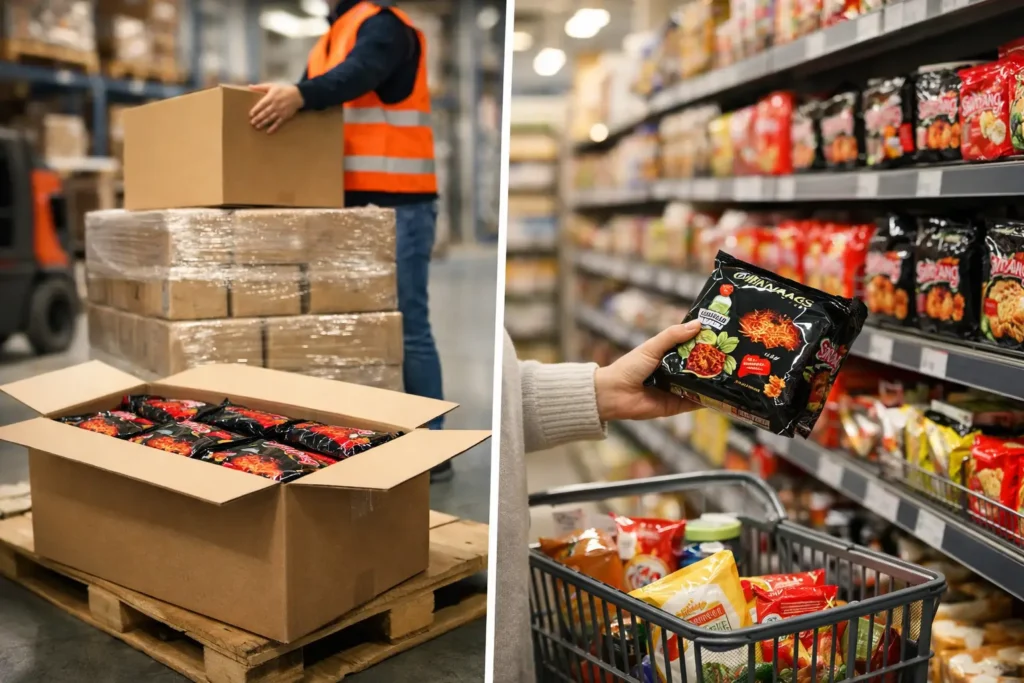
At a surface level, Samyang wholesale vs retail looks like a simple comparison between buying in bulk and buying single units. In practice, the gap is much wider. Retail is designed for end consumers. The price includes the retailer’s margin, local overheads, small-order handling and the convenience of immediate access in low quantities.
Wholesale is structured around commercial demand. Pricing is based on volume, case quantities and ongoing purchasing relationships. It also usually comes with a different level of account support, from documentation and export handling to shipment planning and product availability updates.
That distinction matters because a buyer sourcing for a supermarket chain or a regional distributor is not solving the same problem as a consumer buying a few packs online. One is managing landed cost, sell-through and replenishment. The other is simply making a purchase.
Why retail pricing can mislead business buyers
Many first-time importers start by checking retail prices online or in local Asian grocery shops. That gives a rough indication of market appetite, but it is not a reliable basis for procurement planning.
Retail pricing is often inflated by local distribution layers. A product may have passed through an importer, a wholesaler and a retailer before it reaches the shelf. Each step adds margin. If you compare that final shelf price with a wholesale quote, the difference can look attractive, but it still needs proper analysis.
The real question is not whether wholesale is cheaper than retail. It almost always is. The real question is whether wholesale buying improves your total commercial position after freight, duties, storage, shelf-life management and local distribution costs are included.
For some buyers, especially those testing a new market or launching a limited Korean food range, retail can feel safer because the commitment is smaller. But small commitments often produce weak margins and inconsistent supply, which makes it harder to build a dependable category.
The margin advantage of wholesale
Margin is usually the clearest reason to choose wholesale. If you are buying Samyang products for resale, every additional layer in the supply chain reduces your pricing flexibility. Buying at retail and reselling is rarely a sound long-term model unless the market is highly constrained and volumes are minimal.
Wholesale improves margin in three ways. First, unit cost is lower. Secondly, freight economics tend to improve when products move in larger consolidated quantities. Thirdly, your pricing strategy becomes more controllable because you are not relying on a retail seller whose stock and pricing may change without notice.
That said, margin is not only about the lowest ex-works or FOB number. A slightly higher wholesale price from a dependable supplier can be more profitable than a cheaper source with irregular allocation, incomplete paperwork or poor fulfilment. Lost sales, delayed launches and damaged retailer relationships can quickly outweigh a small cost saving.
Supply consistency matters more than buyers expect
This is where Samyang wholesale vs retail becomes a serious operational decision. Retail channels are not designed to guarantee supply to commercial buyers. Stock can disappear during demand spikes, promotional periods or viral consumer trends. If a product such as Buldak gains sudden attention, retail availability may tighten immediately.
Wholesale supply is different because it is planned around account demand. Commercial buyers need visibility on lead times, case packs, minimum order quantities and replenishment schedules. They also need confidence that a supplier can support repeat business rather than occasional spot purchases.
For distributors and supermarket buyers, inconsistency creates knock-on problems. Empty shelves reduce consumer trust. Purchase teams end up firefighting. Forecasting becomes less reliable. In foodservice, unavailable products can disrupt menu planning and purchasing cycles.
A wholesale-only model is generally better aligned with buyers who need continuity, especially when Korean food is no longer a novelty line but an established revenue category.
Wholesale support goes beyond the product
A retail seller provides goods. A serious wholesale partner should provide execution.
For international buyers, that includes export documentation, commercial invoicing, packing lists, lead-time clarity and coordination across shipping points. It can also include guidance on pallet configuration, mixed product orders and practical ordering structures that suit your market.
This is one of the biggest differences between retail and wholesale that newer buyers sometimes overlook. The product may be the same, but the service framework is not. When you are moving goods internationally, operational support affects both speed and risk.
A business such as SAMYANG FOODS STORE is positioned around that wholesale requirement rather than consumer convenience. That matters for buyers who want a supply partner with bulk-only expertise and cross-border execution, not just access to product images and checkout buttons.
When retail still has a place
Retail is not useless. It has a role, especially early in the buying cycle.
If you want to assess flavour popularity, compare pack sizes or understand how Samyang products are positioned in your local market, retail purchasing can be practical. It also helps when internal teams need to sample products before committing to larger volumes.
For very small businesses, market stalls or trial-only launches, retail may be an acceptable short-term route. But it is usually a bridge, not a destination. Once demand is established, staying with retail purchasing tends to cap growth because the pricing, supply and account structure are not built for scale.
How to decide which model fits your business
The right choice depends on your volume, route to market and operational readiness.
If you are purchasing for one shop with uncertain turnover, retail may help you test demand without taking stock risk. If you are supplying multiple outlets, wholesaling to independent shops, importing for a national account or planning menu integration across foodservice sites, wholesale is the stronger commercial fit.
Ask practical questions. Do you need predictable landed cost? Do you need case or pallet quantities? Are you trying to protect margin across repeat orders? Do you need a supplier that can support export logistics? If the answer is yes to most of these, retail is probably the wrong channel.
Another factor is speed of growth. Korean food categories can move quickly once consumer demand is proven. Buyers who stay in retail channels for too long often struggle to keep pace when reorder frequency rises.
Common mistakes in Samyang wholesale vs retail decisions
One common mistake is focusing only on unit price. Cheap buying does not automatically produce good commercial results. Delays, substitutions and stock gaps can cost more than an apparently better deal saves.
Another mistake is underestimating minimum order quantities. Wholesale improves economics, but only if your business can absorb the stock responsibly. Overstocking fast-moving noodles may be manageable. Overstocking slower specialty lines may tie up cash unnecessarily.
A third mistake is ignoring the difference between a product seller and a trade partner. If your business depends on regular availability, responsive communication and dependable fulfilment, supplier capability should be assessed as carefully as price.
The stronger route for scalable buyers
For commercial buyers, Samyang wholesale vs retail is usually not a close contest. Retail is useful for visibility, sampling and small-scale testing. Wholesale is the route for margin control, stock continuity and planned growth.
That does not mean every buyer should jump into the largest possible order immediately. It means procurement should match business reality. Start with realistic volume planning, choose a supplier that understands international trade requirements and build a purchasing model that can grow with demand rather than react to it.
The Korean food category rewards buyers who think beyond the next order. When demand is strong, the businesses that win are usually the ones that secured the right supply structure early and treated sourcing as a long-term commercial decision.
