Stocking decisions are rarely about taste alone. A proper Samyang carbonara review for retailers has to look at what actually moves product – shelf appeal, repeat purchase potential, price tolerance, audience fit and supply reliability. On those commercial measures, Samyang Buldak Carbonara sits in a strong position: it is a recognisable Korean instant noodle line with proven viral appeal, but it also has broader mainstream potential than some of the hotter variants.
This matters because not every trending noodle earns long-term shelf space. Some products spike on novelty and then flatten. Samyang Carbonara has a better chance than most of sustaining demand because it combines the established Buldak identity with a softer, creamier flavour profile that brings in both heat-seeking shoppers and buyers who want something more accessible.
Why Samyang Carbonara stands out at retail
For retailers, the core advantage is that this product sits at the intersection of trend and usability. The Buldak name already carries strong consumer recognition in many markets, driven by social media exposure, challenge culture and repeat interest in Korean convenience food. Carbonara benefits from that brand equity without relying solely on extreme spice.
That distinction matters. The original very hot variants can perform exceptionally well, but they can also narrow the customer base. Carbonara usually reaches a wider mix of shoppers – younger consumers, first-time Korean noodle buyers, students, Asian food enthusiasts and mainstream customers who are curious but cautious about heat.
From a category perspective, that makes it more than a novelty SKU. It can work as an entry point into premium instant noodles, especially in supermarkets, world food aisles, specialist grocers and convenience-led formats where trial purchases convert into repeat sales.
Samyang carbonara review for retailers: product performance
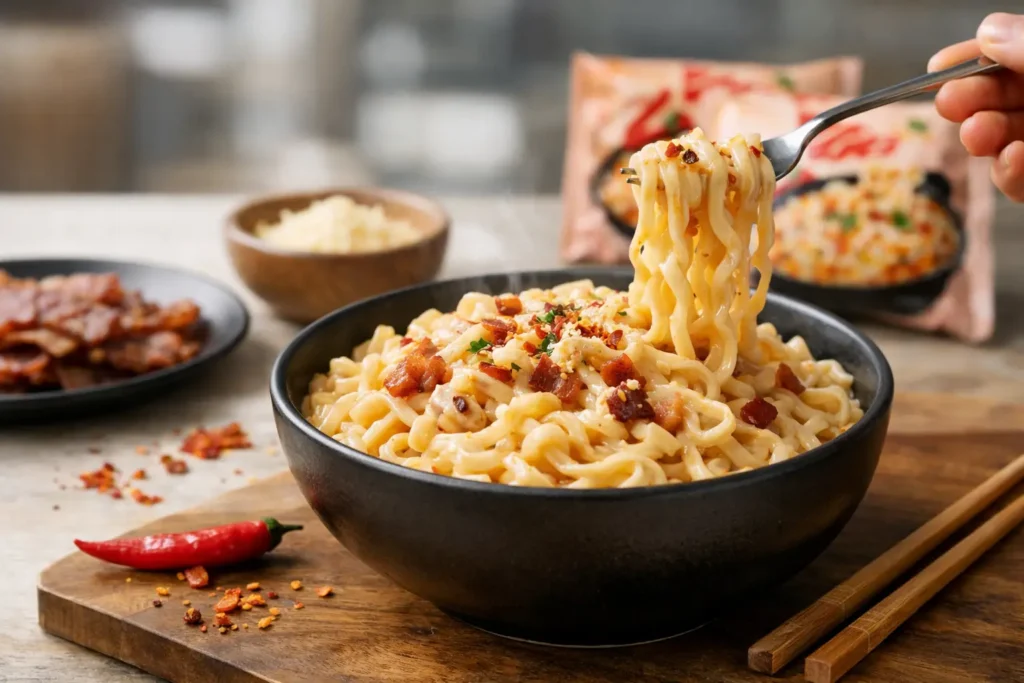
The strongest retail feature is flavour positioning. Samyang Carbonara keeps the familiar Buldak spicy base, but the creamy, cheesy carbonara note rounds out the heat. In practical terms, that gives the product a more balanced profile than extreme fire-focused SKUs. Consumers still get the Buldak experience, but with a richer and more forgiving finish.
That balance has a direct effect on sell-through. Products with broad sensory appeal tend to generate fewer one-off challenge purchases and more genuine repeat buying. For retailers, repeat buying is where margin consistency comes from.
The packaging also works hard at point of sale. The branding is instantly recognisable, and the visual identity communicates both indulgence and spice. On shelf, it stands out without requiring much explanation. In stores where Korean food is still a growing category, that visual clarity helps reduce friction for first-time buyers.
Portion format is another practical strength. The pack feels substantial enough to justify a premium instant noodle price point, which helps retailers defend margin better than they can with lower-value commodity noodle lines. It also suits single-meal consumption, making it relevant in convenience and urban retail channels.
Consumer demand and who is likely to buy
Demand is not limited to one shopper type. The obvious audience is the established Buldak customer who already knows the brand and wants flavour variety. Beyond that, Samyang Carbonara attracts consumers who have seen Korean noodles online, want a branded import product and prefer a less aggressive heat level.
That gives retailers several routes to sale. In Asian supermarkets, it fits naturally beside other Samyang variants as part of a wider branded block. In mainstream grocery, it can perform as a hero SKU within the Korean or instant meal section. In wholesale supply to foodservice or campus retail, it benefits from familiarity and quick preparation.
There is also a gifting and impulse angle. Branded imported noodles often sell not just as pantry staples but as small indulgence purchases. Carbonara is especially suited to this because it sounds familiar to Western consumers while still delivering the Korean spicy noodle identity. That naming bridge can make trial easier.
The only caution is market maturity. In territories where Korean packaged food is still early-stage, retailers may need to avoid overcommitting to too many variants at once. Carbonara is often one of the safer starting points, but ranging discipline still matters.
Margin potential and price positioning
Retailers evaluating this line should think in relative rather than absolute terms. Samyang Carbonara is not a budget noodle. It sits in the branded premium instant category, and that is part of its value. Consumers buying this SKU are typically paying for brand recognition, import authenticity and a differentiated eating experience.
That creates room for healthier margin than generic alternatives, provided the product is sourced efficiently and positioned correctly. Stores that treat it as a premium Korean import tend to hold price integrity better than stores that place it in direct comparison with low-cost everyday noodles.
The commercial upside improves when the product is bought as part of a broader Korean range. Cross-selling with other Buldak lines, sauces, snacks or pantry staples can raise basket value and make the category feel more destination-led rather than single-item led.
Still, pricing needs local judgement. In highly price-sensitive channels, velocity may drop if the shelf price drifts too far above what shoppers consider acceptable for instant meals. In premium urban, specialist or trend-led retail, the same price may feel entirely justified. It depends on customer profile, competitor set and how well Korean food is already established in the area.
Shelf velocity versus novelty risk
One reason this SKU deserves serious consideration is that it has more staying power than many social-media-led food products. Novelty may trigger the first sale, but flavour comfort drives the second and third. Carbonara has that advantage.
For retailers, that means it can function as a dependable mid-range performer rather than a short-term stunt item. It may not always outsell the hottest flagship variant in every location, especially where challenge culture is a major driver, but it often delivers steadier repeat movement across a broader buyer base.
If shelf space is tight, it is sensible to view Carbonara as a core complementary SKU rather than an optional flavour extension. The product broadens the Buldak franchise and helps retailers serve both heat-focused and flavour-focused shoppers.
Operational considerations for buyers
A retailer reviewing Samyang Carbonara should not separate demand from supply. A high-demand imported SKU only works commercially if replenishment is reliable, case quantities are manageable and lead times support the sales pattern. That is particularly true for fast-moving branded noodles, where out-of-stocks can push customers towards substitute brands.
Buyers should therefore assess more than product popularity. Check whether the supplier can support repeat ordering, export documentation, bulk pricing and consistent availability across multiple shipments. For wholesalers and distributors, this is not a minor issue – it is often the difference between a good listing and a sustainable one.
This is where a wholesale-focused partner matters. Businesses sourcing through a specialist operator such as SAMYANG FOODS STORE are not simply buying a popular product; they are securing access to authentic Korean stock within a supply structure built for commercial volumes and international fulfilment.
Where it fits best in the assortment
Samyang Carbonara works best when ranged with intent. In a specialist Asian food shop, it can be part of a wider branded Samyang set that encourages trade-up and flavour exploration. In a supermarket environment, it often performs well as a lead Korean noodle SKU because the flavour concept is more approachable than ultra-spicy alternatives.
For wholesalers supplying independents, the product has broad relevance because it suits mixed neighbourhoods, student catchments and trend-aware shoppers. For foodservice operators, it can also serve as a convenient base item or resale pack, although that depends on the venue model and menu positioning.
The key is not to treat it as just another instant noodle. It is a branded traffic driver within the Korean food category. Merchandised correctly, it helps legitimise the wider range.
Final view on Samyang Carbonara for retail buyers
If the question is whether Samyang Carbonara deserves retail space, the commercial case is strong. It offers recognised branding, broad flavour appeal, premium pricing resilience and repeat-purchase potential that goes beyond novelty. It will not suit every channel in exactly the same way, and results will depend on local price sensitivity and category maturity, but as a Korean noodle SKU with both trend pull and mainstream accessibility, it is one of the more reliable options in the segment.
For buyers building a Korean food range that needs to move consistently rather than merely attract attention, this is a product worth backing with confidence.
